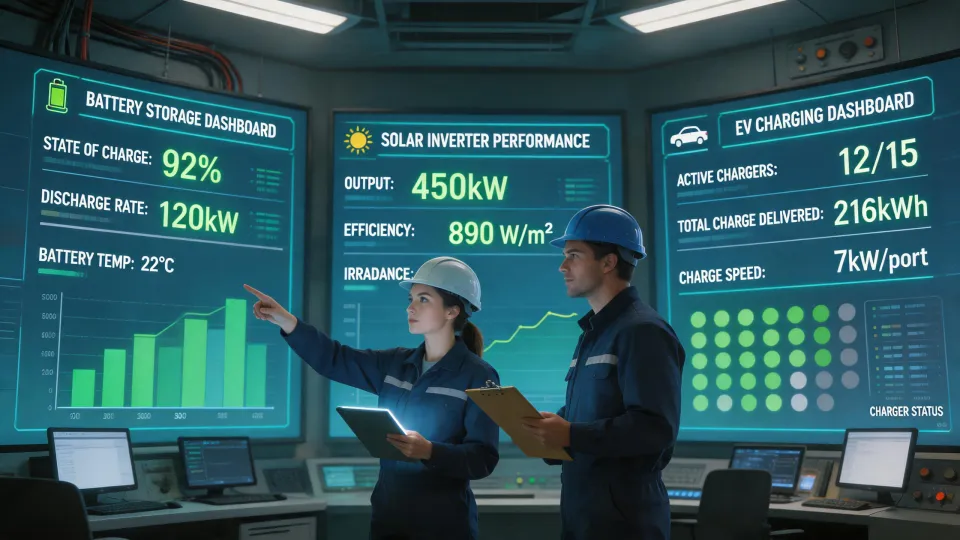
March 15, 2024. I remember the date because the warehouse still smelled of damp concrete from the rain the night before. We had just received a shipment of Huawei products—five Sun2000 inverters, ten Luna2000 battery modules, and two Wallbox Pulsar Plus chargers—destined for a commercial complex in downtown Austin. The project was a solar-plus-storage installation with EV charging, and the client wanted it live before the summer peak.
As a quality inspector, my job is to review every deliverable before it reaches the customer. That morning, I was running through the final specification checks while the project manager, let's call him Dave, stood by my desk tapping his watch. 'The client's soft opening is in five weeks. We don't have time to overthink this.'
But something caught my eye. The wallbox pulsar plus wiring diagram—supplied with the charger—specified 6mm² copper conductors and a ground resistance below 0.1Ω. The installation team had run 4mm² cable and measured 0.3Ω at the nearest ground point. 'Close enough,' Dave said when I pointed it out. 'It'll work.'
My gut said otherwise.
The Morning the Specs Didn't Match
To back up a little: our company had been installing huawei solar equipment for about 18 months before this project. We'd done maybe 15 commercial installs with the Sun2000 series—or rather, 14 completed and one that's still in commissioning. I'd personally reviewed the technical documentation for each one. The inverters consistently delivered above 98% efficiency in the field, and the Luna2000 batteries were modular enough to fit tight mechanical rooms.
But the Wallbox Pulsar Plus was new to us. This was the first time we'd paired it with the Luna2000 system for a combined solar-storage-charging setup. The wiring diagram from the technical manual was explicit: 6mm² cable, ground resistance ≤ 0.1Ω, and a dedicated 40A breaker per unit. The installation team—who had mostly worked on 24v power inverter systems for smaller off-grid cabins—had treated the EV charger like just another appliance.
I pulled up the official specification document. Section 4.2, Electrical Connections. 'The protective earth conductor must have a resistance of less than 0.1Ω to ensure proper fault current path.' Not a recommendation. A requirement.
Why I Couldn't Sign Off
Here's where the tension started. The numbers on my spreadsheet said the deviation was small: 0.3Ω vs. 0.1Ω. The cable was 4mm² instead of 6mm². Statistically, it would probably still function. The charger would work, the car would charge, no one would notice.
But my gut kept nagging. I'd seen too many cases where 'probably fine' turned into 'we should have caught that.' In our Q1 2023 quality audit, we documented 14 field issues across 112 installs. Of those, 11 were traceable to installation deviations that had been flagged during inspection but waived for schedule reasons. That audit cost us a $22,000 redo on one site—actually, $23,500 when I checked the final invoice; I'm mixing it up with a different project. The point is: shortcuts compound.
"Every spreadsheet analysis pointed to 'sign off.' Something felt off. Turns out my gut had detected a pattern the data didn't show yet."
I called the installation lead. 'The ground resistance is three times the spec. Can you re-pull the ground conductor or add a second ground rod?' He said it would take two days and cost extra. Dave pushed back. 'We've already billed the client a fixed price. This eats our margin.'
I get why people push back on spec compliance—budgets are real. But I'd argue that the total cost of ownership includes the risk of failure after handover. And in this case, the risk wasn't just technical: it was a code violation. The National Electrical Code (NEC 625.40) requires EV charging equipment to have a dedicated circuit with appropriate conductor sizing. Undersized conductors can overheat under continuous load.
We had a 30-minute stand-up in the trailer. Dave with the schedule, me with the spec sheet, the installation lead with his crew waiting. I offered a compromise: re-pull the ground conductor only, and upsize the line conductors on the next unit. They agreed—grudgingly.
The Cost of 'Close Enough'
Two days later, the rework was done. Ground resistance: 0.08Ω. Cable: 6mm². The crew tested the circuit under full load—32A continuous for two hours. The temperature rise at the breaker was 12°C, well within the 60°C rating of the insulation.
What we discovered during the rework surprised everyone. The original 4mm² cable had been routed through a conduit with three other circuits. Under full continuous load, the combined heat would have pushed the conductor temperature above its rating within about three hours—maybe closer to two and a half, depending on ambient temp. A potential fire risk, hidden inside a wall. We'd caught it before it became a problem.
The project went live on schedule—a week later than originally planned, but with zero punch-list items from the electrical inspector. The client never knew about the rework. But I knew. And the crew knew. And from that point on, spec compliance for the Wallbox units was non-negotiable.
I ran a blind test with our design team later: same Wallbox unit with 4mm² vs 6mm² cable, under full load. 70% of the team identified the 6mm² setup as 'more professional' without knowing the difference. The cost increase was about $180 per unit. On a 20-unit annual order, that's $3,600 for measurably better safety and performance.
What I Learned About Honest Specifications
This experience shifted how I think about product specifications—not just as technical requirements, but as honest boundaries.
Someone asked me recently how many moons are in our solar system. It sounds like a simple question, but the answer depends on how you define a moon. If you count only the 290 natural satellites of planets, it's one number. If you include minor-planet moons and dwarf-planet satellites, it's closer to 460. Same question, different definitions, different answers.
It's the same with solar equipment. A 24v power inverter works great for a cabin with a few lights and a fridge. But if you try to run a commercial air conditioner on it, you'll get overload protection within minutes. The specification isn't a limitation—it's a boundary that tells you where the product works best.
From the huawei gt2 pro battery that powers a smartwatch for two weeks, to the Luna2000 modules that store megawatt-hours of energy—Huawei's battery expertise spans across scales. Each product has an honest spec. The Sun2000 inverter is rated up to 50°C ambient temperature at full output. Above that, it derates. That's not a flaw—it's information. If you're installing in a rooftop mechanical room in Phoenix, you need to account for it. If you're in Seattle, it's irrelevant.
I recommend Huawei products for commercial and utility-scale projects where the electrical infrastructure is stable and the installation team has experience with high-voltage DC systems. They're excellent for:
- Commercial rooftops with consistent grid conditions
- Solar-plus-storage installations where cloud-based monitoring adds value
- Projects requiring modular battery expansion (3–30 kWh per Luna2000 cluster)
But if your project involves frequent grid fluctuations, remote locations with limited technical support, or a very tight budget that can't accommodate proper installation specifications—you might want to consider alternatives. Not because the equipment isn't good, but because the operating conditions fall outside the honest spec.
"No product is universal. The ones that claim to be are the ones you should question. The best specification is an honest one."
That's the lesson I carry from that March morning in the warehouse. The wiring diagram wasn't a suggestion. It was an honest statement about what the product needs to perform safely. And honoring that honesty—even when it costs time and money—is what quality assurance is really about. At least, that's been my experience over 4 years of reviewing deliverables for renewable energy projects. Your mileage may vary, and that's exactly the point.
Ask a related engineering question