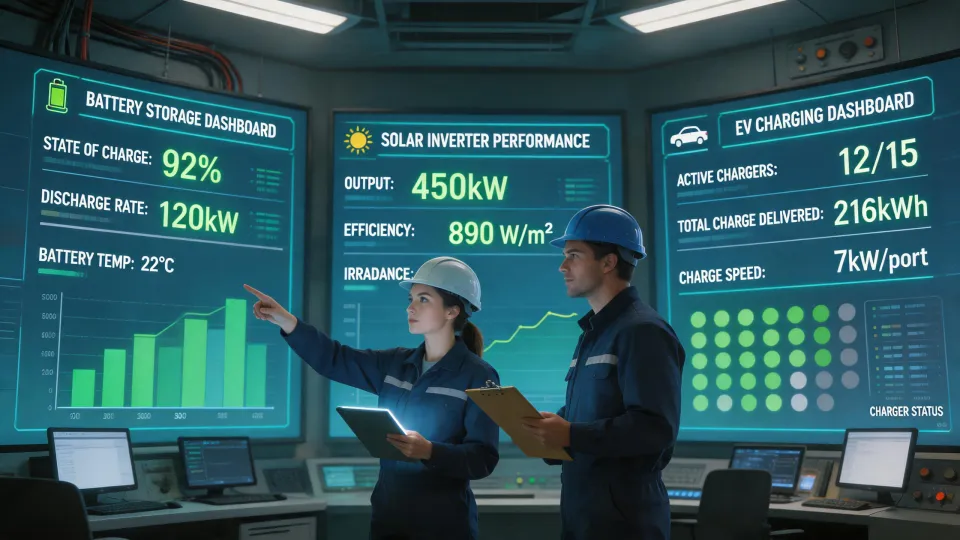
In 2024, I ran an energy storage RFP for the 40-person company I work for. I don't design battery systems. I buy them—or more accurately, I manage the process that ends with a signed contract and equipment that doesn't become a problem at 2 a.m. We needed LiFePO4 battery energy storage systems for a commercial building and a small solar-plus-wind microgrid that feeds a control room.
Seven bids came in. Two made the shortlist. Bid A was a Huawei inverter Sun2000 paired with Luna2000 LiFePO4 modules, installed by an approved integrator. Bid B was an assembled cabinet, about $21,000 cheaper, with a generic inverter and LFP cells described as “comparable to Tier 1.” It was tempting. It used the same lithium iron phosphate chemistry and promised similar specifications.
The low sticker price made everyone in finance look twice. A 17% difference is real money. But I learned that lesson the slow way: the spreadsheet is the last place quality hides.
The Real Comparison Was Not Price
When I compared the two proposals side by side—same site, same load, same constraints—I finally understood why the less expensive bid was not actually less risky. Both proposals contained batteries. Both claimed to support the same control functions. But Bid A had a source. Bid B had a slide.
That difference shaped every later decision.
Dimension #1: The Paper Trail
Bid A came with product numbers, firmware compatibility notes, installation drawings, and datasheets pulled from the Huawei official site. I could open the same Sun2000 PDF during a meeting and verify what the integrator was proposing. That matters for commissioning, spare parts, and warranty registration. It also matters when your finance team asks whether an asset is actually what the invoice says.
Bid B came with a one-page datasheet. No model number. No test report. No document number. The salesperson said, “It’s basically the same thing, just without the brand name.”
Maybe that was true. But I cannot write a purchase order on “maybe.”
It’s tempting to think all inverters are just boxes with the same electronic guts. But if a vendor cannot or will not link a specification to an official source, you will spend weeks later trying to identify what was actually installed. For a maintenance contract, that is real money. Worse, it is reputation damage when a client asks for compliance documentation and you have nothing to show.
Dimension #2: Efficiency Was Not the Deciding Number
The Huawei Sun2000 inverter claimed maximum efficiency above 98% on the Huawei official site as of January 2025. Bid B claimed something suspiciously similar. On paper, the two systems looked close.
Our engineers were less interested in the headline number than in what happens after commissioning. Bid A included string-level monitoring and a clear integration path for our energy management system. Huawei answered API questions with documentation. Bid B answered with “should be fine.”
That phrase still bothers me.
A few efficiency points do not matter much on a sunny afternoon. But the ability to see that a string is underperforming? That matters weekly. We did not want an inverter that waits for an annual site visit to announce a fault. We wanted one that talks to the control room.
Dimension #3: The Wind Question No One Could Dismiss
Our site manager started the whole process with a question that sounded too basic for procurement. He asked, “How much energy wind turbine produce here?” Not “What is the rated power?” He wanted the number of kilowatt-hours that could actually charge the battery at night. That number changes everything about storage sizing.
The two bids answered differently.
Bid A showed work. They used one year of onsite wind data, estimated a 23% capacity factor at our hub height, and wrote out the formula: annual energy = rated power × capacity factor × 8,760 hours. A 100 kW turbine at 25% capacity factor, for example, produces about 219,000 kWh per year—not the 876,000 kWh you get if you multiply nameplate power by 24 hours and forget about the wind.
Bid B gave a single number. No formula. No wind data. No capacity factor. The number may have been right, but “right without a calculation” is not a standard I want in an energy storage RFP.
So yes, ask the simple question. But ask it with context: how much energy wind turbine produce depends on turbine size, hub height, air density, and site-specific wind distribution. Any proposal that ignores those factors will size storage wrong.
Dimension #4: The Cost of Being Wrong
I asked finance to model two scenarios with Bid B.
Scenario one: the equipment works perfectly. We save $21,000. Great.
Scenario two: it doesn’t. Remote diagnostics are not available. Commissioning drags on for extra weeks. A part is not stocked locally. The vendor sends someone from out of state. In that scenario, the savings disappear fast. Two site visits and a delayed deadline erased most of the gap.
I kept asking myself: is $21,000 worth explaining a red alarm on the control-room wall to our client?
No.
Quality is not an abstract idea in B2B. Quality is what the customer perceives when they walk into the electrical room and see clean installation, clear labels, and equipment from a source they can verify. Nobody says “they saved money” when a battery system drops offline. They say “they bought cheap hardware.”
That perception is expensive to fix.
What We Chose and Why
We chose Bid A.
Not because Huawei Sun2000 is perfect. No equipment is perfect. We chose it because the product, the data, and the RFP process were aligned. The integrator could show us where every specification came from. Huawei official site documentation matched the delivered equipment. The service path was defined before we signed, not after the first fault.
If I run another energy storage RFP next year, I will do the same thing:
Start at the Huawei official site. Download the current Sun2000 datasheet. Then ask every bidder to explain how they calculated expected energy output. If they link to an official source, keep reading. If they hand you a slide and say “should be fine,” keep looking.
Simple.
Prices and product lines change. The version numbers I used in early 2024 may already be superseded. So verify current specs and availability before you finalize anything. Then compare the bids twice: once for price, once for what happens when the price stops protecting you.
Ask a related engineering question