-
The Low Quote Was Missing the Context
-
EV Charger Installation: The Real Load, Not the Fancy Hardware
-
Battery Capacity ≠ Usable Energy
-
Software Integration Is Where the Project Lives or Dies
-
How Does Hydrogen Energy Storage Work? (And Why It Wasn't Our Answer)
-
The Cost of Waiting (And the Cost of Cheap)
-
The Solution That Fit (Without Overpromising)
-
Bottom Line
I manage purchasing for a 400-person company, mostly office and light warehouse space. Early in 2024, we took on a project that seemed simple at first: add battery storage to the solar array, put in EV chargers for employees, and flatten our peak-demand charges. Like most people, I started by comparing hardware — browsing the Huawei shop, looking at spec sheets, and asking for quotes.
The quotes came back all over the place. Six vendors, six different lithium battery systems, almost 40% gap between the highest and lowest price. And honestly, the lowest one was for a Huawei lithium battery setup, which I thought was a good sign. But the more I looked, the more I realized the price wasn't the real problem. The problem was everything around the hardware.
The Low Quote Was Missing the Context
The cheapest quote looked great in a spreadsheet. Then the installer walked the site and added the extra line items: electrical panel upgrade, a dedicated grid-interactive connection, permits, and a breaker change. None of that is sexy, but all of it is mandatory.
So the 'cheap' quote stopped being cheap. It was only about 8% below the next bid by the time the scope was identical. And if I'd signed based purely on the unit price, we'd have ended up with a change-order fight later.
This is the part that frustrates me about B2B solar storage. We're all trained to negotiate on the cost of the box. But the box is maybe 40% of the final bill. Installation, electrical work, software setup, and integration are the other 60%.
EV Charger Installation: The Real Load, Not the Fancy Hardware
EV chargers are a perfect example. Someone searches for 'EV charger installation Queen Creek' (or any city, really) expecting a quick quote. But the charger — say, a Pulsar Plus Wallbox — is only a piece of the system. It needs a dedicated circuit, a communication path to the building's network, and sometimes a load management controller. All of that takes time and materials.
A friend in Queen Creek who installs chargers told me: 'The worst jobs are the ones where the customer already owns the charger and expects me to make it work with whatever wiring they had.' That stuck with me. He's seen a $600 charger require a $2,000 panel upgrade before it could even be connected.
(Should mention: our own panel was nearly full. Adding four chargers meant moving circuits around. That was an extra $1,800 that not a single initial quote included.)
Battery Capacity ≠ Usable Energy
Here's something vendors won't tell you: that big number on a battery datasheet is not the amount of energy you can actually pull out. Round-trip efficiency, inverter limits, depth of discharge, temperature derating — all of it eats into the real figure.
The Huawei lithium battery range (the Luna2000 series) is designed to be modular, which is one reason we kept it in consideration. You start with a few modules and add more later. But matching the battery to the Sun2000 inverter is where the engineering happens. The inverter has to be sized for both the solar array and the battery's output. If that ratio is off, you're losing energy or paying for unused capability.
I'm a purchaser, not an engineer. I know just enough to be dangerous. But any supplier should be able to explain round-trip efficiency in plain numbers. If they can't, or they dodge the question, that's a red flag.
Software Integration Is Where the Project Lives or Dies
The next surprise was software. The low quotes often combined a battery from one brand, an inverter from another, and a charger from a third. In theory, that works. In practice, it can mean three apps, three support lines, and a commissioning process where everyone points at someone else when something doesn't work.
What most people don't realize is that a lithium battery system needs to communicate with the inverter, the meter, and the EV chargers if you want any kind of smart load management. Otherwise, the battery charges when it feels like it, and the chargers pull full power at the worst times.
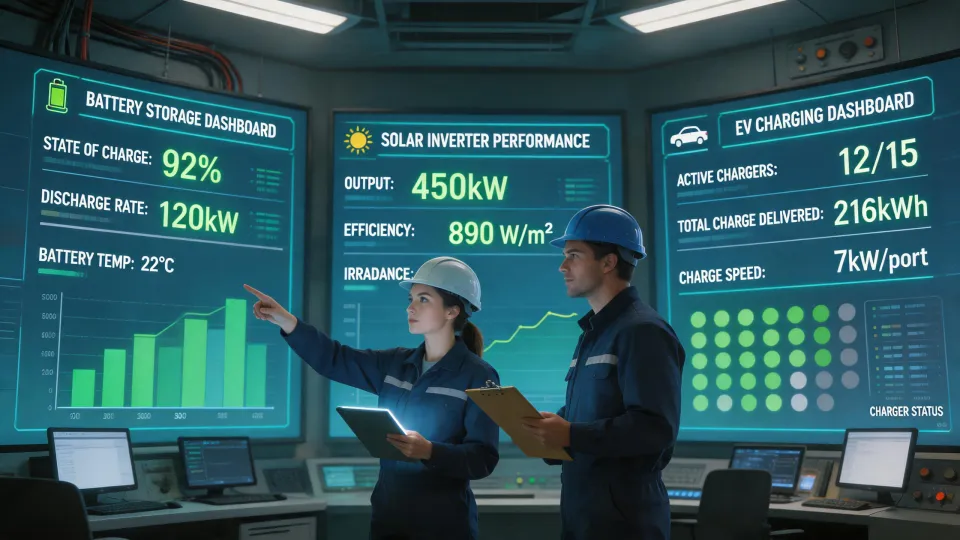
That integration capability is one of the reasons we shifted toward one platform. FusionSolar from Huawei isn't the only option, but it tied the Sun2000 inverter, the Luna2000 storage, and the EV chargers into a single view. For a lean facilities team, that's genuinely valuable.
How Does Hydrogen Energy Storage Work? (And Why It Wasn't Our Answer)
I should stop here and answer a question that came up during our internal review: 'How does hydrogen energy storage work?' It's a fair question, especially when someone is trying to decide whether to wait for the next shiny technology.
So, how does hydrogen energy storage work? It can be broken down like this:
- Excess electricity from solar or wind powers an electrolyzer, which splits water into hydrogen and oxygen.
- That hydrogen is compressed and stored in tanks. It can stay there for weeks without the same self-discharge losses you see in batteries.
- When you need power, the hydrogen goes into a fuel cell. The fuel cell combines hydrogen with oxygen to make electricity and water vapor.
It's clever, and it has a real place in long-duration storage. But the round-trip efficiency is much lower than most people think. Most published estimates for power-to-hydrogen-to-power land in the 30-40% range (see NREL's work on long-duration energy storage if you want the details). A good lithium battery system can hit 85-90% round-trip efficiency.
For our use case — daily peak shaving, solar self-consumption, and EV charging during the day — hydrogen was a distraction. It would have meant more capital equipment, more safety infrastructure, and a much longer payback period. So we stopped waiting and moved forward with lithium.
The Cost of Waiting (And the Cost of Cheap)
The three months we spent evaluating options weren't free. Our peak-demand charges kept hitting the electricity bill every month. The local incentive picture also changed: the 2024 program was less favorable than the one in 2023. To be honest, I don't remember the exact percentage change, but it was enough to matter.
I also know from experience that a low price can become expensive in a hurry. Back in 2021, I approved a lower-priced supply vendor for office equipment. It wasn't the same as solar storage, but the lesson was identical: six months in, the equipment underperformed, the vendor played hardball on warranty, and the replacement cost was double what we saved. Ever since, I scrutinize the lowest quote more than the highest one.
The Solution That Fit (Without Overpromising)
We ended up buying an integrated Huawei system: Sun2000 inverter, Luna2000 battery modules, and the EV chargers managed through the same platform. The charger is a Pulsar Plus Wallbox, which is a reliable unit, and the installation was handled by a local electrician with real experience in Queen Creek EV charger installation projects.
Total cost was about 9% above the lowest bid. It also came with one supplier to call, one commissioning process, and one monitoring dashboard. For a team that doesn't have a solar engineer on staff, that consistency is worth more than the upfront savings.
I'm not saying this is the right approach for every company. If you have a strong engineering team and already own part of the infrastructure, mixing vendors can be rational. And if Huawei's local service coverage is thin in your area, buy through whichever authorized channel you trust. The key is to buy the full capability, not just the hardware.
Bottom Line
If you're looking at a storage project, don't let the hardware spec sheet make the decision for you. Ask about:
- Site infrastructure: panel capacity, conduit paths, and load balancing.
- Usable energy: round-trip efficiency, not just battery capacity.
- Software integration: one platform, or a clear plan to make everything talk to each other.
- Total installed cost: hardware + installation + integration + commissioning.
And if someone tries to sell you on future hydrogen storage for a building like ours, politely ask for the round-trip efficiency math.
My experience is based on mid-sized commercial projects, not utility-scale plants or off-grid sites. If you're in those segments, you should weigh the same questions differently. But the hidden costs of installation and integration? Those seem to show up everywhere.
Ask a related engineering question