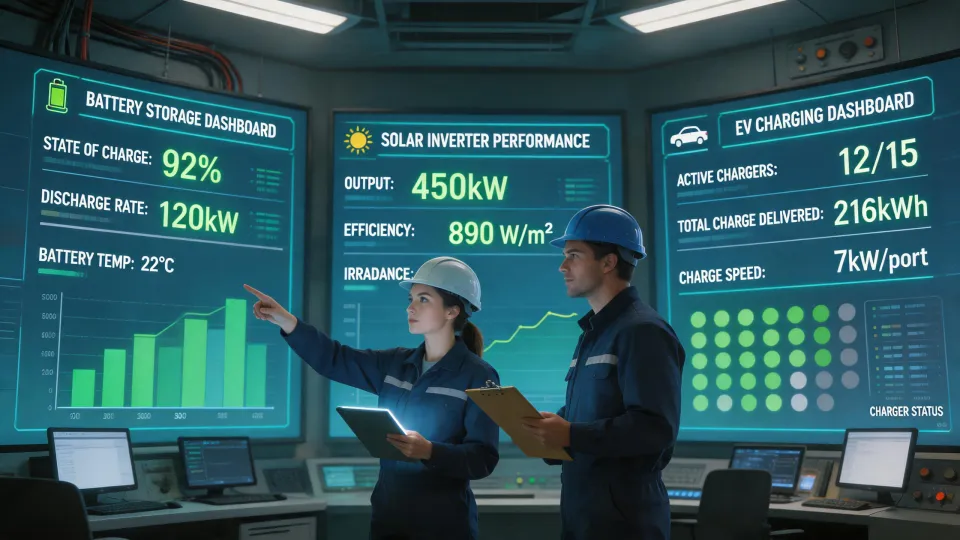
If you're evaluating Huawei solar for a commercial site in 2025, here's the short version: the Sun2000 inverter, Luna2000 battery, and Wallbox charger are a genuinely integrated system, but the decision should come down to grid codes, commissioning support, and total cost of ownership, not just brand familiarity. And if you landed here because of recent Powerwall news, don't pause your project. The storage market has room for multiple platforms, and a Level 2 charger is still the default answer for most commercial EV charging. (More on that below.)
I'm a field operations manager at a renewable energy equipment supplier. I've handled 120+ rush orders in 8 years, including same-day inverter turnarounds for utility clients. Most of those emergencies were avoidable, and that's the lesson I want to share before you make a $50,000 decision.
Why I can say this
In March 2024, 36 hours before a solar-plus-storage site acceptance, a client's inverter went down. Normal lead time was three weeks. We found a Huawei Sun2000 replacement in a regional warehouse, paid about $600 in expedited freight on top of the $4,200 base cost (maybe $4,800 total; I should check the invoice), and had a tech install it by 6am. The alternative was a three-week delay and a $50,000 penalty clause. That's when you realize that spare inventory and good partner relationships are part of the product, not an add-on.
What Huawei actually sells in this space
Huawei's renewable energy division is broad, but you'll mostly see four things in B2B proposals:
- Sun2000 string inverters. These come in residential, commercial, and utility sizes. The 100K and 120K models are common on commercial rooftops and carport projects.
- Luna2000 modular storage. Battery modules stack behind the inverter. I want to say the smallest usable configuration starts around 5 kWh, but don't quote me on that exact number; it varies by market and software release.
- Wallbox EV chargers. AC charging boxes for hotels, offices, factory parking lots, and residential buildings.
- UPS and digital power. More relevant if you're operating data centers, hospitals, or other mission-critical loads.
The FreeBuds 6i battery life connection
Here's something I find curious: a lot of searchers type 'huawei freebuds 6i battery life' and end up on pages about solar equipment. I think Huawei's brand spans consumer audio and grid infrastructure, so that happens. The FreeBuds 6i battery life—I think the official quoted figure was around 8 hours with ANC on and maybe 28 hours with the charging case, though I might be misremembering—is not a reason to buy a commercial battery. But it is a small reminder that Huawei engineers battery management at every scale, from earbuds to megawatt-hour installations. That engineering culture matters, but it shouldn't replace site-level due diligence.
What is a Level 2 charger?
A Level 2 charger is an EV charger that runs on 208-240V AC, the same power an electric dryer or kitchen range uses. It typically delivers 3.3 to 22 kW, adding roughly 18-35 miles of range per hour depending on the vehicle and charger. For comparison, Level 1 uses a standard 120V outlet and adds maybe 3 to 5 miles per hour. Level 3 DC fast chargers run at 50 kW or more and bypass the vehicle's onboard charger entirely.
For most commercial and multi-family installations, Level 2 is the workhorse. The 'prise Wallbox' (French for 'wallbox outlet') is simply the connector unit installed on a wall or pedestal. In specs and invoices, it's the same thing: a dedicated EV charging station with its own circuit, safety protections, and often smart charging features.
Powerwall news and what it means
The most relevant Powerwall news in 2025 is the continued rollout of Powerwall 3 and the fact that, in some regions, lead times are still long. For a B2B buyer, that doesn't mean you should choose a battery based on a headline. It means you should build flexibility into your procurement, and that might include a Huawei Luna2000 option alongside other qualified systems.
Powerwall is a strong home battery. Huawei's Luna2000 is a strong modular option. They solve similar problems in different ways. If you're comparing them, ignore the brand wars and ask three things: Which system is certified by the local utility? Which installer can offer same-week support? What does the extended warranty actually cover? In my experience, the most expensive purchase mistake is choosing hardware before those three answers are clear.
Three questions before you specify Huawei solar
Before you sign anything, run through these:
- What is your load profile? The right storage size depends on your critical loads, not just your annual bill.
- What are the grid connection rules? Some utilities require export limiting or anti-islanding certifications that not every inverter model has.
- Who commissions the system? A certified local installer matters more than the brand on the box.
It's tempting to think you can compare inverter specs on paper. But identical datasheet numbers from different vendors can result in wildly different outcomes. I once watched a great inverter perform badly because of poor commissioning—and that was with good hardware.
I'd rather spend ten minutes explaining the difference between a string inverter and a hybrid inverter than deal with mismatched expectations later. An informed customer asks better questions and makes faster decisions. The buyers who do best are not necessarily the most technical ones; they're the ones with a clear load profile and a clear backup requirement.
Why every urgent call sounds the same
The most frustrating part of this job is that clients call for emergency replacements after the storm, not before. You'd think grid hardening and spare inventory would be budgeted like insurance, but it's usually reactive. After the third late delivery from a discount vendor in 2023, I was ready to stop promising rush anything. What finally helped was building a 48-hour buffer into our internal schedule and keeping one spare Sun2000 100K unit in the warehouse. That's not exciting, but it saved us from a six-figure delay at least twice.
The same pattern happened with a client who bought a cheaper inverter controller that the utility rejected. The vendor said 'it should work.' The utility said no. We paid $2,500 in re-testing fees and lost four days. That changed how I think about backup planning. One critical deadline missed, and suddenly redundancy didn't seem like overkill.
Don't overstate savings (or ignore the FTC)
One more thing: be careful with savings claims. 'Free energy from the sun' is a marketing line, not an engineering spec. Per FTC guidelines (ftc.gov), environmental and energy claims must be substantiated. In our proposals, we show generation estimates, not guarantees, and we flag that utility rate changes can alter payback. That honesty is part of why clients come back. Not that it gets us extra points in weekly meetings, but it keeps the contracts intact.
Where this field guide stops
This advice doesn't apply if:
- You're a single-family homeowner with a 10 kW load. You don't need a C&I inverter; buy the residential product and right-size the Luna2000.
- Your grid connection doesn't allow export. Then storage sizing and inverter settings change completely.
- You need DC fast charging for a public fleet. Level 2 won't cut it.
- Your utility requires specific certifications (UL, IEC, CEI) that a particular Huawei model hasn't received yet. Verify local approvals, not global brochures.
Also, don't use my emergency story as an excuse to procrastinate. The best time to order solar equipment is before the project lands on the critical path. The second-best time is today. Take this with a grain of salt, but I've never seen a rush order that wasn't made worse by a missing specification review.
There's something satisfying about a perfectly executed rush order. After all the stress and coordination, seeing it delivered on time and correct—that's the payoff. But an even better payoff is the less dramatic version: a system ordered correctly the first time, installed calmly, and approved without drama. That's what I want for your project.
Ask a related engineering question