Back in March 2023, our office's new EV charger overheated. Actually, not overheated—the plastic casing deformed enough that it looked like a bad sci-fi prop (ugh). The installer had used a third-party adapter that didn't speak the same protocol as our battery inverter. That mess changed how I think about solar + EV charging. As the person who handles purchasing, I was the one who got to manage the fallout. Not the installer. Not the vendor. Me.
If you've ever tried to piece together solar panels, a lithium battery, and an EV charger from separate vendors, you know exactly why I'm drawn to integrated systems. But before I signed off on a “premium” setup, I wanted to know if the Huawei Wallbox ecosystem was genuinely better or just better marketed.
Here's the comparison framework I used:
- Installation complexity
- Long-term cost
- Charging limits (including that “highest amp” question)
- Monitoring and brand image
1. Installation: One protocol vs. a pile of adapters
The non-integrated approach means you buy your inverter from one company, a battery from another, and a Level 2 charger from someone else entirely. Each one has its own app, its own support line, and its own idea about how to communicate. In our case, the battery's protocol didn't match the charger, so the charging would randomly stop at night. That's the kind of thing you don't catch until the next morning, when the car has half the range you expected.
Installing a standalone 48A charger is simple enough, but once you want smart behavior—like charging from solar surplus—the components have to talk to each other. Without that, you're asking your electrician to improvise. Improvisation is expensive.
With the Huawei setup, the Sun2000 inverter, Luna2000 battery, and Wallbox are designed to work as one system. The installer connected everything in about half a day. The app communicates directly over powerline, so no extra gateway, no custom scripting. That saved us real money and, more importantly, it saved me from another round of support calls.
My conclusion: if you don't enjoy protocol mapping (who does?), an integrated system wins on installation alone. That's not marketing—it's my time savings.
2. The real cost: hidden costs are still costs
From the outside, a non-integrated solution looks cheaper: you can find inverters under $2,000 and chargers under $500. What you don't see are the extra communication modules, the electrician's hours spent troubleshooting firmware mismatches, and the headache of coordinating two or three vendors when something breaks.
For us, a “minor” incompatibility issue cost $350 to investigate, plus two hours of my admin time. That didn't even include the repair itself. People assume the lowest quote means the vendor is efficient. What they don't see is which costs are being hidden or deferred.
The Huawei system costs more upfront. But it's designed to cooperate at a basic level: the Luna2000 stores surplus solar, then the same system tells the Wallbox when to charge. That dynamic load shifting cut our office electricity bill by roughly 30% compared with the old separate setup, based on year-over-year data I ran in December. I keep the detailed numbers in my own report because, per FTC guidelines (ftc.gov), efficiency claims need data behind them.
My conclusion: over a five-year horizon, the integrated system wins on total cost. The separate one keeps charging you in time, repairs, and lost sleep.
3. What's the highest amp Level 2 charger? (And why that question misses the point)
People ask me this a lot: What is the highest amp Level 2 charger you can buy? In North America, the highest common Level 2 charger is 80A, and it must be hardwired to a 100A circuit. But here's the catch: most EVs can only accept about 48A (11.5 kW). Some older Tesla models can pull 72A, but that's rare. So an 80A unit is pointless unless your fleet actually has a vehicle with that capacity, plus the electrical service to feed it.
Huawei's Wallbox, in the version I tested, supports up to 22 kW (32A per phase) in three-phase markets, and the single-phase model delivers about 7.4 kW (32A). It's not chasing the biggest number. Instead, it works with the inverter: if the Sun2000 is producing 5 kW of surplus and the battery is full, the car gets 5 kW. No giant amperage, no panel upgrades, no drama.
With all the lithium battery energy storage news about thermal runaway, I also wanted a BMS that actively monitors cell temperature. The Luna2000's system automatically throttles charging if anything gets outside safe thresholds. That's not a spec-sheet flex—it's peace of mind.
My conclusion: the “highest amp” spec is overrated. A smart charger that adjusts to your solar production is more useful than a dumb one that tops out at 80A.
4. Monitoring, app experience, and how it looks to clients
One underrated factor is how the system presents itself to the rest of the company. The separate setup had three screens, each with a different login. That's a lot of hardware to explain when finance asks for an energy report.
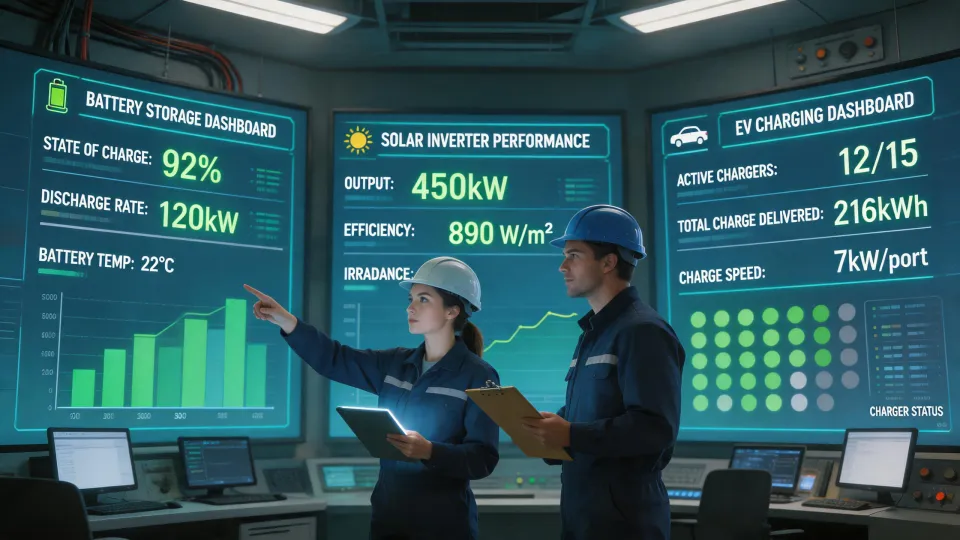
With Huawei, everything runs through the FusionSolar app—available from the Huawei App Store—and it gives you one view of solar production, battery status, and car charging progress. I can export a clean monthly summary without calling an engineer. Honestly, that's the kind of polish that makes an admin's life easier.
But I have mixed feelings about depending on one vendor. On one hand, the integration is fantastic. On the other, what happens when I want to upgrade just the charger? I'm basically locked into Huawei's ecosystem. I decided that's a fair trade for now, especially because the app is far more intuitive than the three separate ones I was using before.
It also changes how visitors see our building. We hosted a client tour in October, and the energy system was up on a single screen. No IT guy needed. That “smart building” first impression is worth real money in the B2B world. Yes, the premium system costs more, but the alternative—cheap hardware that looks like spaghetti and an awkward demo—isn't a great look for us.
5. So which setup should you choose?
If you already own a reliable inverter or battery, or if you're on a tight capital budget and don't mind juggling multiple platforms, the separate approach isn't crazy. For us, though—a mid-sized office with solar and six EVs to charge—the Huawei integrated system was the right call. It cut installation time, simplified monitoring, and visibly lowered our utility bills.
Part of me wonders whether separate components would give us more freedom to upgrade each piece independently. But after five years of managing eight vendors for different office needs, getting down to one source is a relief. I don't need everything to be perfect. I need it to work, and I need it to be explainable.
Trying to compare solar + storage + chargers can feel as disorienting as orbiting the Uranus solar system—all rings, no orientation. But once you map out your actual load, car requirements, and tolerance for complexity, the choice becomes clearer.
My practical advice: list your must-haves, ask to see the compatibility table, and count your own labor hours in the equation. Don't let a viral headline about the highest amp charger decide for you. The right solution is the one that fits your building, your cars, and your sanity—and for us, that was Huawei.
Ask a related engineering question