-
The Framework: Pass-Through Solar Generator vs. Fixed System
-
Safety: Pass-Through Heat vs. Dedicated Power Paths
-
Real-World Efficiency and Monitoring: One App vs. a Dark Box
-
Dual Port EV Charging Station: One Outlet vs. Two Vehicles
-
Solar System Facts to Verify Before You Order
-
Which Should You Choose?
In March 2024, I got a late call from a regional distributor who had four electric delivery vans to charge by 7 am. Their new solar system was still in permitting. The only option they could name was a solar generator. My answer: yes, you can use a solar generator while charging it—or rather, most units let you. But if the goal is continuous EV charging, that is the wrong question.
I am a deployment coordinator at a renewable energy company. In eight years, I have handled more than 200 rush orders, including same-week turnarounds for commercial EV sites. This article compares two ways to handle solar EV charging: a portable solar generator used in pass-through mode, and a fixed solar plus storage system built around a Huawei Sun2000 inverter and a dual port EV charging station.
Honestly, the comparison is not 'what works for a campsite.' It is what works for a building that needs to run a load and charge EV batteries every day. I will walk through three dimensions that often get ignored: safety, sustained efficiency, and scalability.
The Framework: Pass-Through Solar Generator vs. Fixed System
Here is the basic difference. A solar generator is a single box that combines a solar charge controller, battery, inverter, and outlets. Pass-through mode lets you run the outlet while the solar panels are charging the internal battery. A fixed system separates those functions: panels feed an inverter, the inverter feeds the building, and a separate EV charging station handles the car.
Both can charge an EV from sunlight. The difference appears when something gets hot, when a second vehicle is plugged in, or when someone needs to know what the system was doing at 3 am.
Safety: Pass-Through Heat vs. Dedicated Power Paths
Everything I had read about solar generators said pass-through charging was fine as long as you stayed under the wattage limit. In practice, the failures I have seen were not from overloading. They were from heat and continuous operation. When a solar generator is charging its battery and running an inverter at the same time, the heat from both processes sits in one enclosure. A small internal fan is not enough for hours of EV charging.
In March 2024, that lesson became personal. A warehouse with four delivery vans had a contractor run a solar generator in a closet for three days. The battery management system shut it down because of high internal temperature. The vans were dead on a Monday morning. The generator was not defective; it was being used beyond its intended envelope.
I am not an electrical engineer, so I won't pretend to cover every local code requirement. What I can tell you from commissioning sites is that a fixed system has a much easier time rejecting heat. The Huawei Sun2000 inverter is designed with large heat sinks and active cooling because it is meant to sit in a meter room and deliver power continuously. The battery is a separate module with its own thermal management, and the EV charging station has its own contactors and thermal protection.
Conclusion on safety: for occasional emergency use, a solar generator with manufacturer-approved pass-through is acceptable. For anything resembling a daily routine, a fixed system wins. That has been my experience with AC-coupled portable generators under continuous load.
Real-World Efficiency and Monitoring: One App vs. a Dark Box
Spec sheet efficiency is measured at ideal temperature with a specific load. At 3 kW continuous load in a warm room, every component runs hotter, and efficiency drops. The effective throughput of a solar generator in pass-through mode is lower than the sum of its parts because the battery is being charged and discharged at the same time, adding heat and resistance.
Can you use a solar generator while charging it? Yes, but the question is how well it does it for hour five, not hour one.
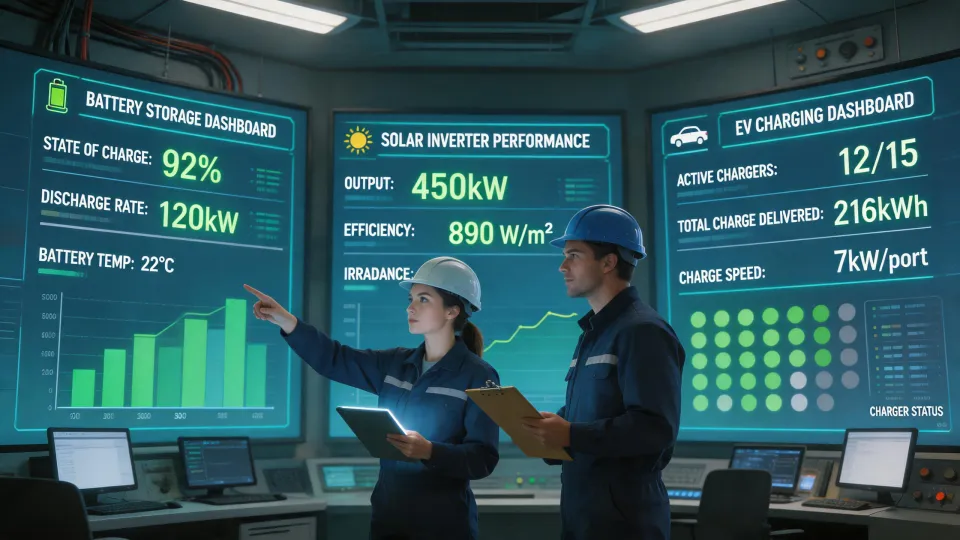
A fixed inverter has the same physics, but more room to handle the heat. The Huawei Sun2000 inverter is a good example: its continuous AC output, wide MPPT voltage range, and monitoring capability make it suitable for daily operation. If you are using Huawei hardware, the FusionSolar app is available through the Huawei App Store, and it lets you see inverter output, battery state of charge, and EV load in one dashboard. In an emergency call, that visibility saves hours.
Here are the solar system facts that matter: panels produce DC, the inverter converts it to AC, and an AC EV charger is just a load with its own electronics. The inverter's continuous rating, not the peak rating, determines how much EV charging you can really do from solar. This applies to every system, including a solar generator.
Conclusion: for short bursts, a solar generator can be efficient. For sustained output and operational visibility, a fixed inverter system is more trustworthy.
Dual Port EV Charging Station: One Outlet vs. Two Vehicles
This is where most solar generator plans fall apart. A typical solar generator has one AC outlet, or two outlets sharing one inverter. A splitter on a high-continuous-load circuit is a workaround, not a solution.
A dual port EV charging station lets two vehicles charge at once with load balancing. It can throttle the second connector when the inverter or service is near capacity. A solar generator does not do that. If the combined draw exceeds the inverter limit, it trips both outlets.
On a fixed setup, the dual port station can be paired with the Huawei Sun2000 inverter and, if you add storage, a Huawei Luna2000 battery. When solar drops and battery is low, the station can reduce charge current instead of dropping the site. That load management is the difference between a site that survives and a site that calls me at 11 pm.
Conclusion: if you ever need two EVs charging at once, a solar generator is a backup tool, not a primary charger.
Solar System Facts to Verify Before You Order
I keep a checklist for every emergency quote. It is the cheapest insurance I know.
- Look for the exact pass-through statement in the manual. If it says 'temporary use only,' believe it.
- Check the inverter's continuous AC output, not the surge rating.
- Confirm that a dual port EV charging station supports load management. Otherwise two EVs on a 40 A circuit will trip the breaker.
- Check the battery's maximum charge and discharge current. In a solar generator, those happen in the same compartment, so heat adds up.
- For a Huawei Sun2000 inverter, the datasheet lists maximum efficiency, but the number that matters is the site's expected daily kWh production.
- Download the monitoring app only from official sources. On a Huawei phone, that means the Huawei App Store.
Oh, and one thing I should add: the solar generator manual said pass-through was for temporary use. Most people never see that phrase because it is buried in the fine print.
The prevention point is simple: five minutes of verification beats five days of correction. Most of my emergency calls would have been avoidable with a checklist.
Which Should You Choose?
Choose a solar generator if you need mobile power, you understand the pass-through limit, one vehicle at a time is acceptable, and you can keep the unit in a ventilated area. For a temporary fix, it is better than nothing.
Choose a fixed system with a dual port EV charging station if you have regular EV charging needs, you are designing for more than one vehicle, you want remote monitoring, and you want a system that can operate continuously. Pairing it with a Huawei Sun2000 inverter gives you a purpose-built power path and a clear upgrade path if you add battery storage later.
After three failed solar generator rescues, I now only specify fixed inverters for sites that charge EVs every day.
Can you use a solar generator while charging it? Yes, on most units, and only if the manufacturer says the pass-through mode is rated for the load and environment. That answer is useful for an emergency. For a permanent site, the better answer is a fixed system where the inverter, battery, and dual port EV charging station all have their own thermal management, their own monitoring, and their own job.
This was accurate as of early 2025. Solar hardware changes fast, so verify current specs and local codes before you commit. And if you are not sure, get a second opinion from someone who has pulled the trigger on emergency replacements before. Five minutes of checking is a lot cheaper than a 2 am call.
Ask a related engineering question