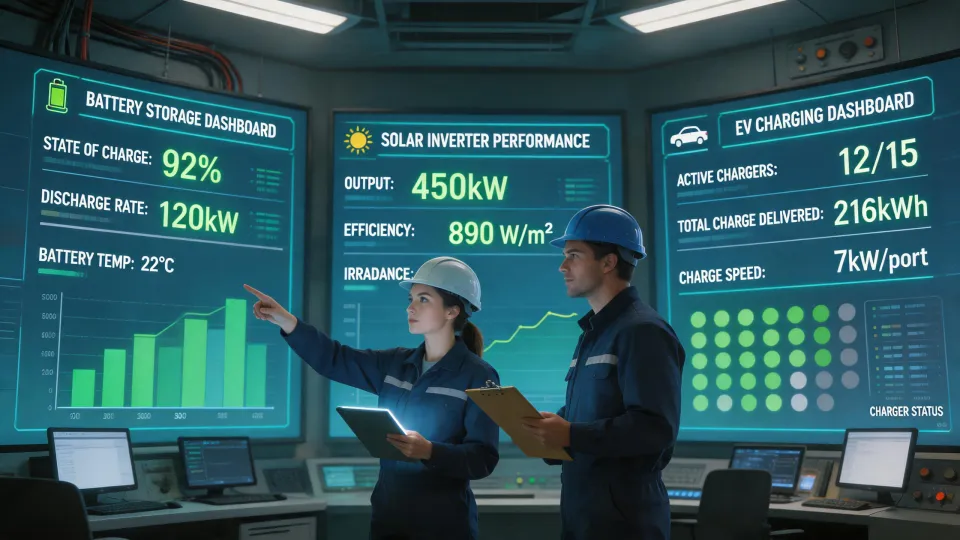
- The Inverter Is the Most Important Solar Component. Most Buyers Don't Treat It That Way.
-
Sizing a Solar System for 1,000 kWh Per Month: A Back-of-the-Envelope Check
-
EV Charger Quality: What "Dodging a Bad Charger" Really Means
-
EcoFlow Delta Pro Ultra vs Tesla Powerwall 3: A Quality Inspector's Read
-
The Counterargument: "But the Other System Has Better Numbers"
-
My Bottom Line
Most solar buyers don't have an equipment problem. They have a specification problem.
I'm a quality inspector at a solar equipment manufacturer. I review roughly 200 inverters, batteries, and charging systems a year—or maybe 180, I'd have to check the system—before they ship to utility projects and commercial installers. Over four years of this, I've rejected my share of first deliveries. And the pattern I keep seeing is that buyers obsess over the wrong details. They compare peak wattage when they should compare thermal behavior. They stare at cycle counts when they should ask what happens after year five. They want the biggest battery when they need the most reliable one.
Here's what actually deserves your attention in 2025.
The Inverter Is the Most Important Solar Component. Most Buyers Don't Treat It That Way.
Granted, solar panels get the attention. But I can tell you from the quality side: a mediocre panel with a reliable inverter will outperform a premium panel with a finicky one, because downtime eats your yield.
When I compared two 50 kW sites side by side—same panels, same racking, one with a Huawei Sun2000 inverter and one with a cheaper brand—I finally understood why a high-efficiency spec sheet matters less than who's actually monitoring the system. The cheaper one produced about 12% less over a summer because two strings were partially fouled by dust and nobody noticed until the utility bill arrived.
What "Reliable" Actually Means in an Inverter
From my review desk, here's what I check before anything else:
- Efficiency at partial load. The Huawei Sun2000 series lists max efficiency above 98% on many models—the exact number depends on model and region, so don't let anyone quote a single figure. But here's the thing: a 1% difference between two inverters at full load is small. What matters is whether the inverter keeps that efficiency at 20–60% load, because that's where your system lives most of the time.
- Environmental sealing. IP66-rated enclosures keep out water and dust. This sounds basic, but I've opened inverters in field audits that looked like they'd been on a beach vacation because the cooling fan pulled in sand. It's more common than buyers assume.
- Arc-fault protection. AFCI isn't a buzzword. It's the difference between a stopped string and a structural fire. The Sun2000's arc-fault detection is on par with the best in the industry—I won't name competitors, but the safety-test files speak for themselves.
- Monitoring and diagnostics. This is where "Huawei support" stops being a slogan and becomes an operational fact. The FusionSolar platform lets installers see per-string current, not just a total number. On a 100 kW commercial site, that's the difference between a 15-minute fix and a week-long investigation.
This was accurate as of January 2025. Inverter lineups change fast, so verify current models before you budget.
Sizing a Solar System for 1,000 kWh Per Month: A Back-of-the-Envelope Check
A large share of B2B requests start with the same sentence: "I want a solar system for 1000 kWh per month." Some contractors answer with a price before doing any math. That's how clients get burned. I'd rather spend 10 minutes explaining the calculation than deal with mismatched expectations later.
Here's the version I give to every buyer who asks:
- 1,000 kWh per month divided by 30 days is roughly 33 kWh per day.
- Divide that by your location's peak sun hours. Most U.S. locations get between 3.5 and 5.5 average full-sun hours per day. Start with 4.5 unless your installer shows you local data from a solar resource tool.
- That gives you ~7.3 kW DC of solar array: 33 ÷ 4.5 = 7.3.
- Now add the real-world layer: inverter clipping, soiling, panel degradation, voltage drop. I usually pencil in 10–15% headroom, which suggests an 8 to 8.5 kW array.
Don't hold me to this as a formal design. It's a coffee-napkin sanity check. Your local installer will produce a detailed simulation—I just want you to be able to check whether their number is in the same universe as yours.
One more thing. Inverter sizing—the DC/AC ratio, if you want the term—is a real discussion. A 7.6 kW inverter paired with an 8.2 kW array is a common, sensible combination. I've flagged vendor proposals in past audits where the AC side was oddly oversized. No, wait—undersized, I'm mixing it up with another audit. This is exactly why I write things down. A 4 kW inverter on an 8 kW array will clip way too much on sunny days. Get the ratio checked by a licensed electrical engineer if you're at all unsure. That costs a few hundred dollars and can save you years of regret.
EV Charger Quality: What "Dodging a Bad Charger" Really Means
The other keyword I see in our pipeline is "dodge ev charger." And I know most searches aren't about the car brand—they're from facility managers trying to dodge a cheap charger that will fail under commercial use. They've seen enough marketplace specials fail to know better.
If you're literally driving a Dodge EV—the Charger Daytona comes to mind—the same rule applies: it has a standard connector, so a universal wallbox works with it. The connector isn't the risk. The electronics are.
From a quality control standpoint, here's what I look for in any wallbox, including the Huawei Wallbox (I inspect them, so I'm biased, but the checklist is the same):
- Continuous current rating. Can it deliver its rated current for hours without derating? Poor units overheat and trip on hot afternoons.
- Weather sealing. Outdoor installation requires an IP rating of at least IP54. The Huawei Wallbox meets this.
- Dynamic load balancing. This lets a charger share a utility feed without tripping the main breaker. On commercial sites, it can avoid a panel upgrade that costs more than the charger itself.
- Manageable access control. RFID or app-based authorization, so a public-ish parking lot doesn't become a free charging station for the neighborhood.
We received a batch of 300 wallbox enclosures back in Q1 2024 where the gasket alignment was visibly off against our IP54 spec. Normal tolerance is ±0.5 mm. The vendor said it was "within industry standard." We rejected the batch, and they redid it at their cost. Now every contract includes the gasket compression test. I share this because it's the difference between buying a charger rated IP54 and one that actually is IP54.
EcoFlow Delta Pro Ultra vs Tesla Powerwall 3: A Quality Inspector's Read
I get asked this comparison constantly. It's not as simple as spec-vs-spec, so let me give you the honest framing I'd give a client.
Quick context, as of January 2025:
- Tesla Powerwall 3: 13.5 kWh usable capacity per unit, roughly 11.5 kW continuous output, with an integrated solar inverter. It behaves like a permanent part of the electrical system—whole-home backup, gateway, the works.
- EcoFlow Delta Pro Ultra: modular 6 kWh building blocks (expanding into large configurations with additional units), solid AC output, and a design that's more appliance-like. You can start small and grow it incrementally.
Both are solid. But here's my opinion: the Powerwall 3 is a building component, and the Delta Pro Ultra is an appliance. Neither is better in a vacuum—the right pick depends on whether you're building for a 30-year structure or a phased project.
To be fair, EcoFlow's modular approach has a real advantage for facilities that want to start small: lower initial commitment, and you can expand without buying a whole new system. The Delta Pro Ultra is also easier to relocate, which can matter for rental sites or temporary commercial setups.
On the other side, the Powerwall 3's integrated inverter reduces the number of boxes on the wall, and Tesla's installed base means there are licensed installers who know it well. Wait, that's the practical side. The quality side: in my inspections, the things that fail in storage systems aren't just the cells. They're the contactors, the communication boards, the cooling fans, the user experience. In battery cycles—no, I'm not going down that rabbit hole. The short version is that thermal management and service access matter more than chemistry marketing.
Even after choosing our own product set, I keep second-guessing the storage aspect. What if we'd recommended a different architecture for a client's harsh climate site? The months until the first summer heat test passed were stressful. That's why I tell clients: don't buy on a spec-sheet fight. Buy based on who can service the unit in five years, how the system behaves under partial load, and what the monitoring actually shows you.
The Counterargument: "But the Other System Has Better Numbers"
I get why people want a quick winner. But the spec sheet is the beginning of the conversation, not the end.
Peak output numbers are measured in controlled conditions you may rarely see. Continuous steady-state behavior at your actual load profile matters more. At least, that's been my experience with commercial-scale projects.
Battery cycle life depends far more on the battery management system—how it handles charging at low temperatures, how it balances cells, how aggressively it derates on hot days—than on the raw chemistry label. I've seen premium-chemistry packs perform poorly because the management software was conservative to the point of shutting down.
Future-proofing often means overbuilding, which has its own hidden cost. Extra capacity that sits underused means batteries cycle at shallow depths and sit at odd states of charge for long stretches. That's not always good for long-term health. There's also a term for the money you spend on kilowatt-hours you never use: capex regret.
Around this time, people usually ask me: "So what should I buy?" The honest answer is boring. Choose an inverter with a real field track record and monitoring that you actually log into. Size for the sun where you live, not the sun in the brochure. Buy a charger with load balancing from a company that tests enclosures. Pick storage based on service access, integration simplicity, and the shape of your loads—not just the number on the label.
My Bottom Line
An informed client asks better questions and makes faster decisions. That's the whole point of this piece.
The best solar and storage system in 2025 is the one you can verify, service, and trust. I've built a career on rejecting things that don't meet spec, and the most expensive mistakes I see are never the brand names. They're the skipped calculations, the unverified installers, and the comparisons that oversimplify real trade-offs.
Do the math, check the support ecosystem, and ask the uncomfortable quality questions before you sign, not after.
Ask a related engineering question