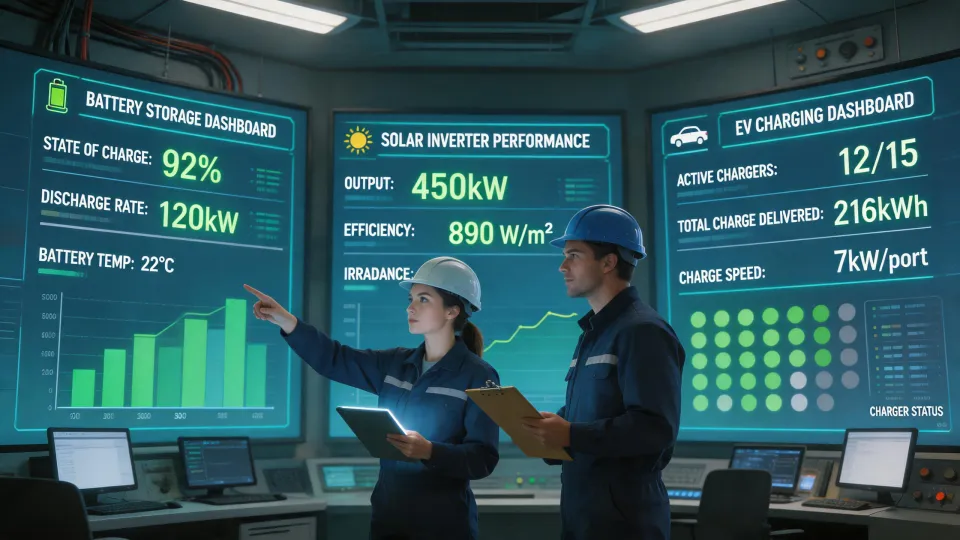
I got the call at 4:17 PM on a Tuesday in March 2024. The client—a regional utility company—had a problem. Their main grid substation for a new commercial park was delayed by six weeks. But the park's anchor tenant, a data center, was already on site and ready to commission. The penalty clause for delaying the data center's go-live? $50,000 per day.
They needed a temporary, but fully functioning, solar-plus-storage microgrid. And they needed it operational in 36 hours. Not 36 days. Hours.
Welcome to my world. I'm the guy who triages the impossible deadlines. In my role coordinating emergency power solutions for commercial and utility clients, I've processed over 200 rush jobs in the last four years. But this one? This one almost broke our system.
The Setup: What We Thought We Needed
Normal turnaround for a project like this is about three weeks. You spec the equipment, verify site conditions, coordinate with the local utility for interconnection, get permits, install, test, commission. We had none of that time.
The initial request from the client's engineer was specific: they wanted a 100kW solar array coupled with a 200kWh battery system. Their reasoning was simple—match the baseline load of the data center's non-critical systems.
Here's the thing: when you're under the gun, the first solution that comes to mind is often wrong. I've seen it happen a hundred times. The pressure to deliver makes everyone skip the hard questions. So I asked the first one: 'What's your actual, confirmed load for the next 72 hours?' The answer was a guess. They'd assumed, but they hadn't measured.
We found our first process gap before we even sourced the parts. We didn't have a formal 'emergency validation' process for client load data. It cost us a scare when we had to re-spec the battery from 200kWh to a more modular 300kWh configuration—which we could only do because of Huawei's Luna2000 architecture.
The Twist: The Vendor That Couldn't Handle Speed
With the revised spec, we needed the hardware fast. Normal procurement channels said 10-14 days. Our first call was to a discount vendor we'd used for routine orders. They promised same-day shipping. That was a mistake.
In my experience, discount vendors are fine for restocking panels you already have. For a time-critical emergency deployment, they're a liability. The order confirmation went through, but three hours and a dozen phone calls later, we discovered the inverter they had in stock was an older generation model—not compatible with our chosen battery modules. They didn't have the Sun2000-100KTL-M1 we needed. They just took the order and hoped to find one.
I killed that order and called our dedicated account team at the Huawei shop—a resource I ignored in the scramble. Within 45 minutes, they had the correct inverter and battery modules reserved at a regional distribution center 200 miles away. The catch? The distribution center closed for inventory in 2 hours. We had 90 minutes to confirm payment and shipping logistics.
The Decision: Expensive, But Correct
Had 90 minutes to decide. Normally I'd get three quotes, verify shipping costs, and run a P&L on the rush fees. But there was no time for that. I went with the Huawei supply chain based on a single criteria: trust from past performance.
We paid $800 extra in rush freight on top of the $12,000 base cost for the equipment. In hindsight, I should have just started with the official distributor. But with the CEO waiting for a go/no-go, I made the call with incomplete information. The alternative—a failed deployment and a $50,000/day penalty—made that $800 look like a rounding error.
The Execution: What Actually Worked
The equipment arrived at 6:30 AM the next day—just 16 hours after the call. Three things made this possible:
- The modular design of the Luna2000 battery. Stackable means you don't need a crane or extra electricians for installation. One person can handle a 5kWh module.
- The integrated setup on the Huawei FusionSolar app. No separate configuration tool needed. The energy monitor app was live and reporting within 15 minutes of power-up.
- The client had already done a level 2 charger install for their EV fleet. That site survey and existing 480V infrastructure gave us a known starting point. It wasn't perfect for our setup, but it was a baseline we could work from.
One more thing: the client's facility manager asked where to buy a solar generator for their backup office. I told them they already had one—the Luna2000 can act as an emergency power supply without solar input. It's a where to buy solar generator solution that already exists in their system.
The Result: Live at Hour 34
We commissioned the system with two hours to spare. The data center began its commissioning process on schedule. The utility company avoided the penalty. Our client was relieved, but also nervous—they realized how close they'd come to disaster.
But here's what I learned: speed is the enemy of proper planning. We got lucky because we had a modular, high-efficiency platform from Huawei. But luck is not a strategy.
The Reckoning: What I'd Do Differently
After that project, our company implemented a new policy: for any rush deployment under 72 hours, we require a live site walk-through—not just a load sheet. We also established a direct procurement channel with three tier-one manufacturers, including a dedicated account manager at the Huawei shop for emergency parts.
What was best practice in 2022 may not apply in 2025. The fundamentals—knowing your load, verifying your supply chain, testing your assumptions—haven't changed. But the execution has transformed. Digital power solutions with cloud-based monitoring and modular hardware have made rush jobs more survivable.
If you're planning a solar+storage deployment, I have one piece of advice: spend the first 10% of your timeline (or your budget) on validation. Push back on the 'need it yesterday' requests if the data isn't clean. And for the love of everything, don't call a discount vendor for an emergency job. Call the official channel first.
Your project might not have a $50,000/day penalty waiting for it. But it will have a penalty—lost trust, wasted budget, a burned reputation. And in this industry, that's the one thing you can't buy back with a rush fee.
Ask a related engineering question