-
When I First Started Comparing Solar Quotes, I Was Doing It All Wrong
-
The Problem Everyone Focuses On: Price Per Watt
-
The Deeper Issue: Hidden Costs You Didn't Budget For
-
What This Means for Your Bottom Line
-
The Real Cost of Ignoring Digital Management
-
How an EV Charging Station Works—and Why It Matters for Your Energy System
-
The New Frontier: Transparent Solar Modules
-
Here's What I Do Now (And What You Should Do)
When I First Started Comparing Solar Quotes, I Was Doing It All Wrong
When I first started evaluating solar inverters and battery systems for our commercial facility, I assumed the lowest per-watt quote was the best choice. That was three years ago, and I've since managed about $400,000 in cumulative spending on energy equipment across six installations. Let me tell you—I learned the hard way that sticker price is just the beginning.
My initial approach: get three quotes, pick the cheapest. Sounded logical, right? But after our first system underperformed by 22% in year one, and we paid an extra $5,600 in unplanned maintenance, I realized that "cheap" can be the most expensive option in the long run.
The Problem Everyone Focuses On: Price Per Watt
Most buyers—and I was guilty of this too—obsess over the upfront cost. They ask: "What's your best price per watt?" They compare inverters by their initial invoice and pick the one that saves them a few thousand dollars. That's the surface problem.
But here's the thing: the question they should be asking is, "What's my total cost of ownership over 10 years?" And that changes everything.
The Deeper Issue: Hidden Costs You Didn't Budget For
In my experience, there are five categories of hidden costs that routinely derail budgets:
- Installation complexity – Some inverters require specialized mounting or extra wiring. One vendor quoted $1,200 for "standard install," but our site needed a $3,800 custom rack. Guess who paid the difference?
- Monitoring & management – If your system doesn't include a cloud-based monitoring platform, you're blind. We had a string failure go undetected for two months because the basic inverter didn't have real-time alerts. That cost us 1,200 kWh of lost generation.
- Maintenance & repairs – The cheapest inverters often have the worst support turnaround. Ours had a 45-day lead time for replacement parts. Meanwhile, we lost production.
- Integration with existing systems – Adding EV chargers later? Need UPS backup for critical loads? Not all inverters play nicely with other equipment. Some vendors charge extra for protocol adapters or proprietary communication modules.
- Future expansion – Modular systems cost more upfront but let you add storage or panels later without replacing the whole inverter. Cheap systems lock you in.
The assumption is that price determines quality. Actually, quality determines lifecycle cost. The vendors who deliver reliable, well-integrated systems can charge more because they know their equipment saves you money over time. The causation runs the other way.
What This Means for Your Bottom Line
Let me give you a real example from our second installation. We chose a lower-cost inverter based on the $0.12/W quote. The upfront savings were $9,000 compared to the premium option. But over the next three years:
- Field failures triggered two service calls at $1,200 each
- We lost 12% generation efficiency due to a firmware bug that took 8 months to patch
- The monitoring portal required a separate $300/year subscription
- When we added EV charging stations later, the inverter couldn't communicate with the charger controller—we had to buy a $2,400 gateway
Total added cost: $8,900. That "savings" evaporated. And we still had a system that underperformed the premium option in reliability.
Per FTC guidelines on advertising (ftc.gov), claims like "best efficiency" must be substantiated with evidence. But in practice, the gap between lab-tested efficiency and real-world performance can be significant when the system isn't properly managed.
The Real Cost of Ignoring Digital Management
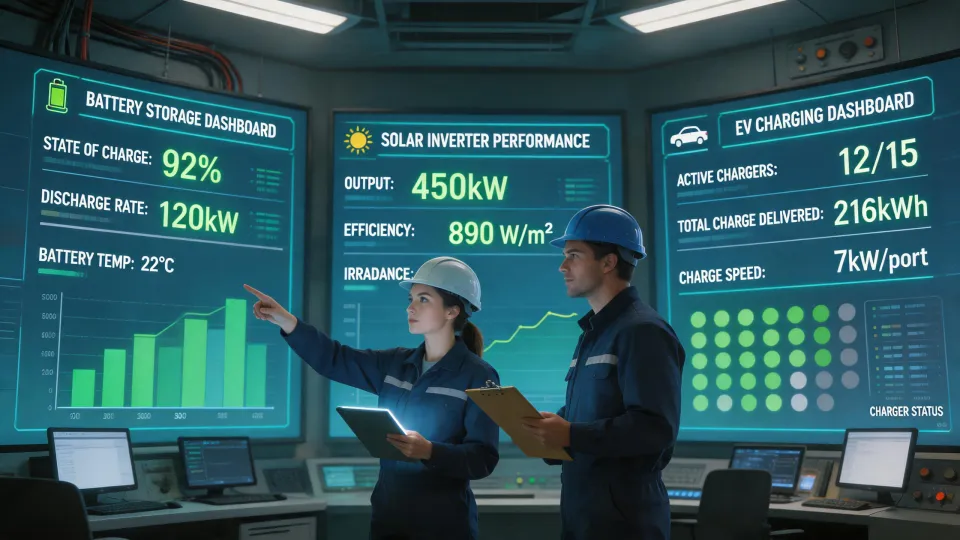
This is the blind spot most buyers miss: the value of integrated software. A modern solar inverter isn't just a power converter—it's a data hub. With cloud+AI capabilities, you can monitor string-level performance, predict maintenance needs, and optimize energy flow between solar, battery, and loads.
When we finally switched to a system with built-in digital management—the kind you log into via a mobile app (huawei login) to see real-time generation and consumption—our operational costs dropped. The system automatically detected a shading issue and recomputed production forecasts. No manual intervention needed. That's efficiency as a competitive advantage.
Switching to an efficient digital process cut our troubleshooting time from 5 days to 2 hours. Seriously, it's way more than just a convenience—it directly impacts your ROI.
How an EV Charging Station Works—and Why It Matters for Your Energy System
If you're considering adding EV charging to your commercial facility, the same cost-of-ownership logic applies. An EV charging station works by converting AC power from the grid (or DC power from solar and batteries) into the appropriate voltage for the vehicle's battery. But its real value depends on how well it integrates with your solar inverter and storage.
- Smart charging – A modern station can schedule charging during solar peak production, reducing grid draw.
- Load balancing – The inverter and charger together can manage total facility load to avoid demand charges.
- Energy management – One dashboard for solar, storage, EV chargers, and UPS backup.
This is where total cost of ownership (TCO) really shines. The upfront premium for an integrated system is often recouped within 2–3 years through lower demand charges, reduced maintenance, and higher self-consumption of solar energy.
The New Frontier: Transparent Solar Modules
You might have heard about transparent solar modules—glass that generates electricity while letting light through. It's an exciting technology for building-integrated photovoltaics (BIPV). But from a procurement perspective, here's what you need to know:
- Current efficiency is around 5–10%, versus 20%+ for conventional panels
- Cost per watt is significantly higher
- But for aesthetic applications (windows, facades), the dual function can offset some structural costs
Don't assume transparent solar is a replacement for standard panels. It's a niche complement. At today's pricing, it won't pass a strict TCO analysis for most commercial projects—unless you're specifically after architectural integration. Keep your eye on the total cost, not the novelty factor.
Here's What I Do Now (And What You Should Do)
After eight vendor comparisons and six years of tracking every invoice, my procurement process is simple:
- Demand a TCO spreadsheet – Ask vendors to break down not just equipment cost, but installation, commissioning, monitoring, maintenance, and expansion costs over 10 years.
- Insist on live remote monitoring – No system without a digital management platform. Period. The risk of blind operations is too high.
- Plan for integration – If you ever plan to add batteries, EV chargers, or UPS, make sure the inverter supports seamless communication (MODBUS, CAN, or cloud API).
- Check warranty and support SLAs – Response times matter. A 24-hour replacement SLA beats a 30-day return-to-depot warranty every time.
Take it from someone who's been burned: the cheapest quote is almost never the cheapest system. The real value comes from equipment that's designed for total lifecycle performance—backed by digital tools that let you see, predict, and optimize every kilowatt-hour.
That's the approach that saved us 17% on our annual energy budget after the switch. Not bad for a procurement manager who started out believing sticker price was king.
Ask a related engineering question