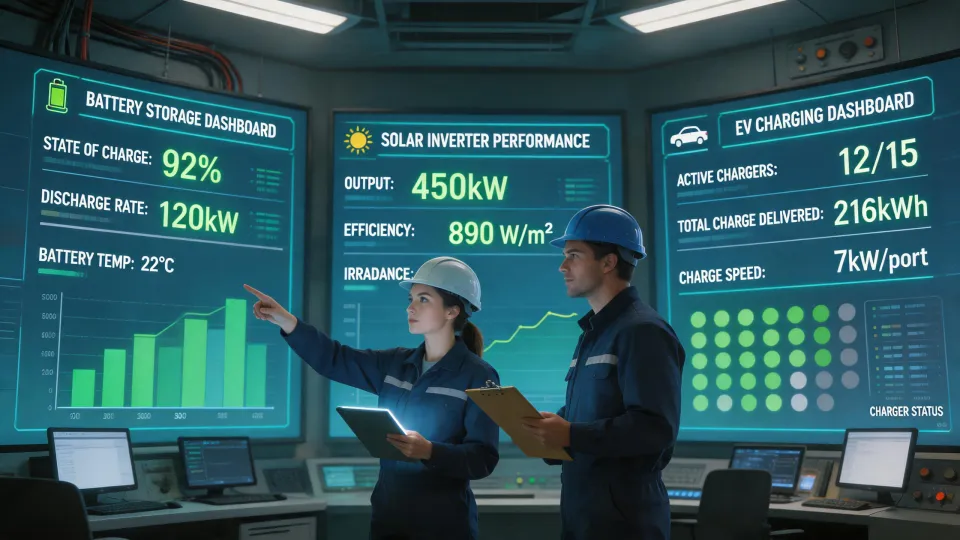
Last year, our company decided to put solar on two of our buildings. And “someone” had to figure it out. That someone was me—the office administrator who usually buys printers and chairs. I manage purchasing for about 400 employees across three locations (Dubai, Lahore, and our HQ), and I report to both operations and finance. This project was bigger than anything I'd handled before: longer timelines, bigger numbers, and a learning curve about energy storage that I did not expect.
If you're asking the same questions I was, here's what I wish a stranger had told me from day one:
- What is energy storage, actually?
- Does AI in energy storage matter, or is it hype?
- Inverex or Huawei: which solar inverter works for Pakistan?
- How do I verify the Huawei official website?
- What does a FreeBuds Pro 2 battery replacement teach you about buying batteries?
- What's the one question to ask a vendor before signing?
What is energy storage, actually?
Energy storage is exactly what it sounds like: a system that stores electricity so you can use it when you need it, not just when it's generated. In the solar world, that basically means a lithium-ion battery. The panels make surplus power during the day, the battery holds it, and you draw on it in the evening instead of buying from the grid at peak rates.
Four specifications actually matter. Capacity (kWh) is how much it holds, and it's the number everyone quotes first. Power (kW) is how fast the battery can release energy—important if you're running equipment with high startup loads, not just lights.
Round-trip efficiency is how much you get back out versus what you put in; Huawei's Luna2000 series, for example, publishes around 90%. Cycle life is how many charge-discharge cycles it survives before degrading to 80% capacity. That last number is the one I'd watch.
I had to explain all of this to our finance team in exactly those terms (they liked the part about peak rates). The IEA's 2024 battery report noted that energy storage is scaling faster than almost any other clean technology, which matched what we saw when the quotes came in. But honestly, the global market doesn't matter for your decision. Your building's load profile—and your utility's rate structure—does.
Does AI in energy storage actually matter, or is it marketing?
Honestly? I was skeptical. “AI in energy storage” sounded like a software sticker on a hardware product. I had the causation backwards: I thought the battery was the real thing and the AI was a gimmick on top. Actually, it's the opposite. A battery's lifespan depends on how it's managed. An intelligent battery management system predicts your loads, checks the weather forecast, and decides when to charge, when to hold, and when to discharge. That's not a bonus feature. It's what keeps the cells from being stressed into an early grave.
Huawei's FusionSolar platform does this continuously through cloud monitoring. Their published cycle ratings for the Luna2000 assume that intelligence is doing its job—turn the software off and you're flying blind. So when a vendor quotes a storage system without a real management platform, ask them to justify the replacement timeline. That's where the hidden cost of a “cheaper” system shows up.
Inverex or Huawei: which solar inverter did we pick for our Pakistan office?
We have an office in Lahore, and the local manager asked us to include solar for that building. In Pakistan, Inverex is the name that comes up first. It's a local brand with strong market share, local support, and a noticeably lower upfront price. When the Inverex solar inverter Pakistan quote arrived, it came in about 30% under Huawei's. I went back and forth for two weeks.
What the paper didn't show: Huawei's quote included commissioning and the monitoring platform. The Inverex quote listed the inverter and nothing else—installation and remote monitoring were extras, and warranty service depended on which district you bought from. I've been burned by cheap quotes before, so I asked both vendors for a line-item breakdown. The 30% gap shrank to about 12%.
We went with Huawei because our energy team sits in Dubai, and the FusionSolar platform gives us the same dashboard for both sites. NEPRA's net metering rules in Pakistan determine export tariffs, and Huawei's inverter documentation around grid-limit settings was a lot more detailed.
Even after I confirmed the order, I kept second-guessing. I didn't relax until commissioning day, when both systems came online in a single afternoon.
To be clear: Inverex is a legitimate option for local, straightforward setups. For a cross-border project like ours, Huawei was the right fit.
How do I verify the Huawei official website?
This should have been my first question, not my fifth (note to self: in this category, verification comes before price). There's a serious grey market for Huawei inverters. The hardware is real, but it was never sold through Huawei's authorized channel—which means no warranty and no firmware updates.
Three steps I now recommend to anyone:
- Open the Huawei official website from the URL in the product manual, not from a search engine. I've seen promoted ad links that point to unauthorized resellers.
- Check the serial number on Huawei's product verification page. It takes two minutes.
- Ask whether the supplier is an authorized Huawei partner before you talk price. Huawei publishes the partner directory for each country, including Pakistan (as of late 2024, at least).
Red flags I've learned to spot
The same red flags show up whether I'm buying office furniture or a $15,000 inverter: a price obviously below market, an invoice that doesn't pass finance's tax checks, and a warranty that's only “through us.” I do not trust any of those three—not anymore. I've learned to ask “what's NOT included” before “what's the price.”
The question nobody searches for: what does a Huawei FreeBuds Pro 2 battery replacement have to do with solar storage?
Stick with me here. My own Huawei FreeBuds Pro 2 earbuds started losing battery life noticeably after about two years of near-daily use. I looked into a battery replacement, and the service cost came to nearly half the price of a new pair. So I bought a new pair. Annoying, but a small event.
Here's why it matters for energy storage. When a lithium battery falls below roughly 80% capacity, the product still works—but the value it delivers drops with it. For earbuds, that means charging them more often. For a building battery, that means less energy shifted, smaller savings, and a worse payback on the original investment.
Huawei's Luna2000 storage batteries are rated for around 6,000 to 8,000 cycles depending on the model—a decade or more in normal commercial use. But that rating assumes optimal operating conditions. The warranty is what tells you what happens if degradation happens faster than promised. Look for capacity-loss coverage, not just outright failure protection. If the fine print only protects the vendor, that's a deal-breaker (note to self: read the capacity-loss clause before signing anything).
What's the one question I ask every vendor before signing?
“What's NOT included?”
In 2023, I approved a UPS order because the unit price was lower than our regular vendor's quote. Classic rookie mistake: I compared unit prices and skipped the total cost question. The shipment arrived with handwritten receipts that our finance system rejected. It cost the department about $2,400 and one very uncomfortable meeting with my VP.
Since then, I assume anything not listed in the line-item quote is not included. Installation. Cabling. Commissioning. Monitoring dongles. Software subscriptions. Permits. If it's not written down, it will be an add-on later. That applies to solar inverters the same way it applies to office printers.
The vendor who lists all fees upfront—even if the total looks higher—usually costs less in the end.
Bottom line: buy through a verified seller, read the capacity-loss terms in the warranty, compare total cost of ownership instead of unit price, and if a deal only works while you're trusting the vendor's word over documented specs and invoices—walk away. Those are the six answers I wish I'd had before I started. Hopefully they save you the tuition I paid.
Ask a related engineering question