I'm the office administrator for a 90-person manufacturing company in Castle Rock, CO. I've been managing purchasing since 2020, which means I've processed a lot of quotes—some good, some bad, and a few that looked good until they weren't. I report to both operations and finance, so my job is to make the numbers work and keep the building running. I'm not an engineer. So when our CFO asked me to explore renewable energy, I did what any non-engineer would do: I Googled the basics.
The first search was “what is the center of our solar system” because I wanted to start with the fundamentals. The sun, obviously. Then I moved on to “renewable energy solar panels wind turbines,” because that's what everyone pictures when they hear “clean energy.” Panels on the roof, turbines on the hill. That mental image was the problem.
The Surface Problem: We Were Buying Hardware, Not a System
The surface issue seemed simple. We wanted lower demand charges, more local generation, and charging for the growing number of electric vehicles in our parking lot. So I started collecting quotes for solar panels and looked into EV charger installation Castle Rock CO as a separate project. Each quote had a price per watt, an expected production number, and a warranty. On paper, they were fine.
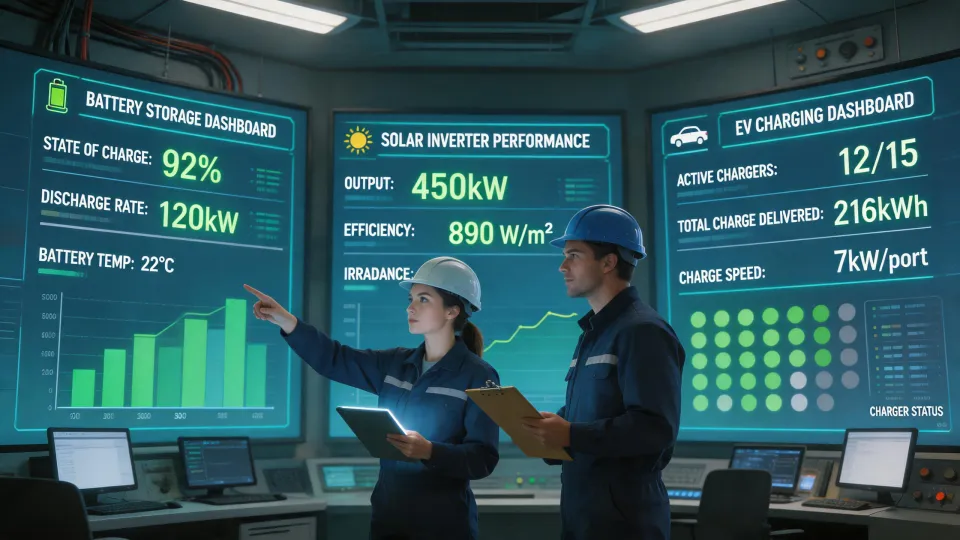
But none of the quotes explained how the pieces would work together. The panels produce DC. The EV chargers need AC. The building runs on 480V three-phase. A wind turbine, if we added one, would need its own power conversion hardware. Somewhere in the middle, a box has to convert, synchronize, and protect everything. That box is the inverter.
And in the first round of proposals, the inverter was just a line item at the bottom. A name, an efficiency number, a price. I didn't know enough to ask the question that actually mattered: Is this inverter the center of the system, or just the cheapest box that can accept the wires?
The Deeper Problem: The Inverter Is the Center, Not an Accessory
I kept thinking about the astronomy search. The center of our solar system is the sun, and every calculation about orbits and seasons starts there. A solar project works the same way. The physical center might be a metal cabinet on the wall, but the functional center is the power conversion and control point. If that point is weak, everything else underperforms—even if the panels are top-tier.
This is where my research changed direction. I started reading through Huawei products—not the phones, but the digital power line: Sun2000 inverters, Luna2000 storage, and Wallbox chargers. On the Huawei official site, the datasheets list things like MPPT voltage range, weighted efficiency, backup switching time, and communications protocols. That's more useful than a single “peak efficiency 98%” number. A string inverter with a narrow MPPT window will lose production early in the morning and late in the afternoon, even if the peak number looks great. That kind of detail doesn't show up in a three-line quote.
I should add that the inverter is also the safety and compliance hub. In the U.S., industry standards like NEC Article 690 assume the inverter will handle rapid shutdown, arc-fault detection, ground-fault detection, and utility interconnection. If you buy panels and turbines without thinking about the control layer, you can end up with code violations and expensive rework. The panels may work perfectly. The system around them won't.
The Real Cost of Getting This Wrong
Let's make this concrete. In our first round, a sales rep recommended a “budget-friendly” inverter that would have saved about $2,100 upfront. It was a legitimate brand, so the risk didn't seem obvious. I ran the specs through a simple production model, and here's what happened: the cheaper inverter had a narrower MPPT voltage range and a lower maximum input current. On Colorado afternoons, our planned 410W panels would clip more often. The annual production loss was around 6 percent—maybe 5.5 percent after more careful modeling, but you get the order of magnitude. Over 15 years, that lost production was worth more than $31,000 in avoided electricity. The “cheap” inverter wasn't cheap. It was a $2,100 discount that cost us the equivalent of a small contract.
I've made this mistake before. Saved $80 by skipping expedited shipping, ended up spending $400 on a rush order. Chose a budget vendor that couldn't invoice properly, and finance rejected $2,400 in expenses. The renewable energy version is just bigger. The system lasts 15 to 25 years, and the equipment decision is locked in on day one.
The EV charger piece makes it worse. EV charger installation Castle Rock CO looks like a simple electrical job: mount the unit, run the wire, done. But a Level 2 charger is a large load. If the panel and inverter are already near their limit, you're looking at demand charges or a service upgrade. One quote we saw for four chargers was $4,800. The actual project, including load management and the transformer study, came to around $9,300. That's not a shady vendor. It's the difference between buying appliances and designing an energy system.
A Smarter Way to Plan Commercial Renewable Energy
We eventually stopped leading with the solar panels and wind turbines. We started with the center: the load, the inverter, and the control logic. The hardware became a consequence of that analysis.
Three things changed:
- We sized the inverter and storage from actual building consumption and planned EV loads, not from roof area.
- We checked the manufacturer's system architecture before comparing prices. For us, that meant reading through compatibility docs and commissioning guides on the Huawei official site. If the inverter and battery aren't designed to talk to each other, you'll end up paying a third party to make them talk.
- We treated EV charger installation Castle Rock CO as part of the energy system—not as separate electrical work. Load management, metering, and time-of-use strategy matter more than the charger's appearance.
If you're looking at Huawei products, use them as a way to understand what modern digital power can do. The Sun2000 isn't just an inverter; it's a controller with monitoring and diagnostics. The Luna2000 battery is modular, so you can add capacity without replacing the base unit. The Wallbox can coordinate with the inverter. Those are the kind of details that make a system resilient five years after installation.
The center of our solar system is the sun. The center of a commercial solar system is the inverter.
So, what is the center of our solar system? The sun. And in a renewable energy project, the center is the power conversion and control equipment—the inverter, the storage, and the software that connects them. Panels and turbines get all the attention. The center is what makes them useful. Start there, and the rest of the system will follow.
Ask a related engineering question