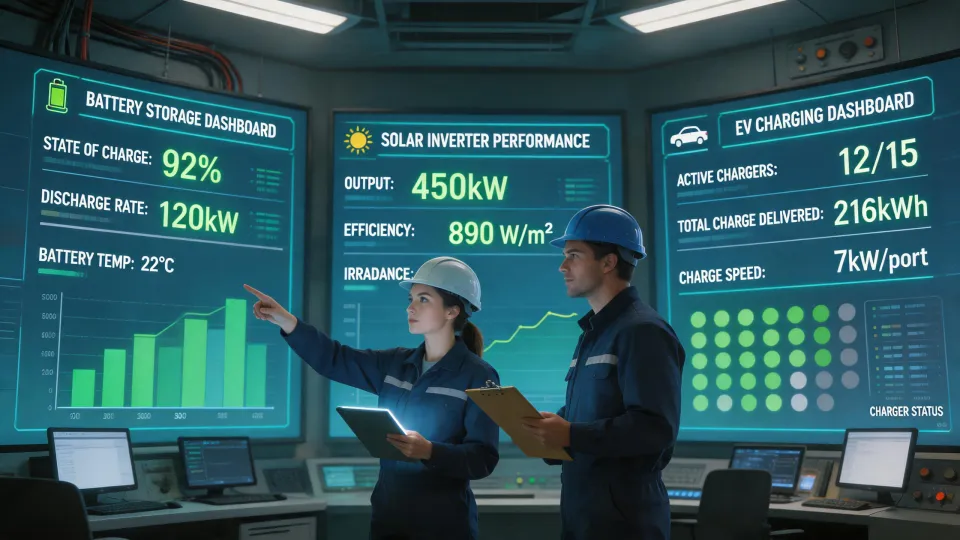
If you've ever juggled a solar inverter quote while staring at a project deadline, you know the feeling: the cheaper option calls your name, and the premium option has to survive the monthly procurement review. I manage purchasing for a 60-person solar installation company, and I've spent the last seven years tracking every inverter, battery, and charger order in our cost system. This is my comparison of two routes I see most often: the integrated Huawei setup (SUN2000 inverter, Luna2000 storage, and now a Huawei EV charger) versus the budget route built from separate components like a Hart Power Inverter and an off-the-shelf MPPT charge controller.
If you follow Huawei energy storage news, you've seen the Luna2000 pushed hard into the commercial and industrial market. It deserves attention, but the bigger question for me is cost of ownership, not the press release. I'm not going to tell you Huawei is always the answer. I am going to compare four things that show up on my P&L: upfront price, energy harvest, monitoring and control, and delivery certainty.
1. Upfront price vs. total cost of ownership
In Q4 2024, I priced two ways to spec a 10 kW array with 10 kWh usable storage and one EV charger. The Huawei package (SUN2000-10KTL, Luna2000 10 kWh, Huawei EV charger) came to $8,650. The budget stack (Hart Power Inverter, generic 10 kWh LFP battery, basic wallbox) came to $6,980. That is a $1,670 difference (about 19 percent more for the integrated system, if you're keeping score). On the quote, the budget route wins. Prices from Q4 2024 quotes; verify current rates.
Then the hidden costs appear. The budget quote did not include the monitoring gateway, the DC isolator, or commissioning support. Those extras added $580 (surprise, surprise). And the warranty on the Hart Power Inverter only covers parts for 8 years unless you pay for an annual inspection. At $150 per visit, that's $750 over a five-year ownership window. Here's something vendors won't tell you: the first quote is almost never the final price. For the Huawei package, the quote included the monitoring dongle, the backup box, and two-year commissioning support. No surprise invoices.
For a B2B buyer, that premium buys a single vendor who is accountable for the whole system. That has real value when something fails at 6pm on a Friday. I built a cost calculator after getting burned on hidden fees twice. My policy now: every inverter quote gets a five-year TCO line, not just a price. When I ran that TCO for this comparison, the budget route ended up $1,250 higher than the Huawei route. The counterintuitive conclusion: the cheaper option costs more by year five. If you have a system that lasts longer, the gap only widens.
2. Energy harvest and the MPPT setup trap
Efficiency is where the second big difference lives. According to Huawei's published specs for the SUN2000-10KTL (verify current model on huawei.com), peak efficiency is 98.4%. The Hart Power Inverter lists a peak efficiency of 97.0%. That 1.4 percentage point gap sounds small. On a 10 kW array in Germany with an annual yield of 950 kWh per kWp, it's around 133 kWh per year. At €0.30 per kWh, that's about €40 per year. Not huge, but it compounds.
MPPT tracker count matters even more. The SUN2000 has two MPPT trackers, which lets you put east-facing and west-facing strings on separate trackers without losing morning and evening production. The Hart unit has one tracker. If the roof has multiple orientations, one tracker clips production at peak. That's a silent loss you won't see on the spec sheet.
How to set up MPPT solar charge controller without paying an installer
If you choose the budget route on an off-grid system, you'll probably ask yourself: how to set up MPPT solar charge controller without paying an installer? I made this mistake once on a workshop building, and it cost me a battery's worth of cycle life. Here's what I wish someone had told me:
- Connect battery first. The controller needs battery voltage to detect system voltage. If you connect solar first, many units just show a blank screen.
- Check Voc against the controller's max input voltage. On cold days, solar panel open-circuit voltage rises. If it exceeds the limit, the controller can burn out.
- Set the battery profile before turning on PV. Gel, AGM, and LiFePO4 need different absorption and float voltages. Leaving it on the default sealed profile is a red flag.
- Program equalization only for flooded lead-acid. One equalization cycle on a lithium battery can trip the BMS protection.
- Use the correct wire size. Voltage drop changes the MPPT operating point. The controller compensates, but you lose yield.
The steps aren't hard. They just take time. If your hourly rate is anything like mine, that time belongs in the cost comparison. If you are in North America, NEC 690.8 covers conductor sizing for PV circuits. In the EU, IEC 60364-7-712 is the standard for photovoltaic supplies. Your local code always overrules a blog post.
3. Monitoring, the EV charger, and the E.ON Gutschein wallbox
This is where the gap is widest. Huawei's FusionSolar app shows PV generation, battery state, and EV charging in one dashboard. The budget route means two or three apps, no shared API, and more late-night troubleshooting calls. Trust me on this one: the app matters.
The Huawei EV charger (the wallbox version) pairs with the inverter to charge the car mostly from solar surplus. For a commercial warehouse with a delivery fleet, that is a no-brainer. FusionSolar also handles export limiting, which is becoming a requirement in more EU grid contracts. The E.ON Gutschein wallbox offer can look tempting on price, but it's just a charging station. It does not know the inverter exists. If you only need a dumb charger, fine. If you want to minimize grid export, the lack of communication will cost you energy you could have used.
Also read the E.ON Gutschein wallbox details carefully. Vouchers often cover the hardware only. Installation, grid registration, and the electrician's second meter can add €400 to €700. Following Huawei energy storage news won't tell you that.
4. Delivery certainty: the cost that hides in lead times
What most people don't realize is that 'standard turnaround' often includes buffer time that vendors use to manage their production queue. It is not necessarily how long your order takes.
In March 2024, we had a commercial project tied to an EU grant. The grant required an EV charger to be installed by the end of the month. Our budget supplier said 'probably ten working days' for the Hart Power Inverter. We got it in 21 days. We missed the pre-approval window and lost a $15,000 incentive. Looking back, I should have paid for expedited shipping. At the time, the standard window seemed safe. It wasn't.
After that, I added a 'delivery certainty premium' line to my spreadsheet. On a Huawei order, that premium was $400, about 4.6 percent of the package cost, and it bought a confirmed delivery window. The next project had a $14,000 grant. The choice was obvious. Now I quote two line items on every invoice: equipment price and delivery certainty. The second one is ignored until you miss a deadline.
When people read Huawei energy storage news, they focus on cycle life and discharge depth. I focus on whether the pallet arrives when promised. Time certainty is a real expense item.
What should you buy?
If you have a deadline, a commercial customer, and you want one warranty and one app, the Huawei integrated package is worth the premium. That's especially true if the Huawei EV charger needs to coordinate with solar storage. The budget route makes sense if you're building a small off-grid system, you know how to set up MPPT solar charge controller yourself, and the project has no grant or client deadline. In that case, a Hart Power Inverter plus a separate battery can work fine.
If you're on the fence, run the TCO before you run the calculator.
Bottom line: the cheapest quote is not the cheapest installation. It took me a missed grant and one expensive workshop battery to learn that. If I could redo that decision, I'd build the TCO spreadsheet before the first quote, not after the second failure. But given what I knew then, with price as the only KPI, I understand why I didn't.
Ask a related engineering question