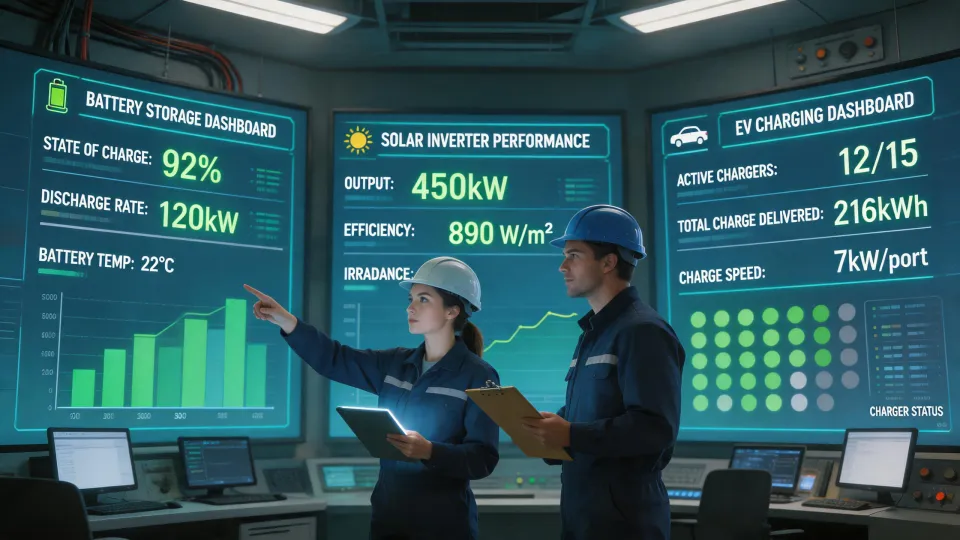
If you are researching solar and battery options, you are probably focused on the panels or the big battery. Stop. The single most important component is the hybrid inverter, like a Huawei SUN2000. It is the brain that decides if you use your solar power, charge your battery, or pull from the grid. I learned this the hard way after managing commercial supply orders for years. The 'cheapest quote' for a system almost always skimps here, and that costs you in the long run.
Before I go further, I need to be clear: I am an office administrator who manages purchasing for a mid-size company. I handle about $150,000 annually across 8 different vendors, mostly for facilities and operations. After a few painful experiences with hidden costs and underperforming equipment, I became the person who reads the fine print on technical specs. When my boss asked me to evaluate a solar + storage proposal for our new building, I brought that same skepticism. This is what I found.
Forget Panel Wattage for a Second: Focus on the Inverter's Job
The core function of a hybrid inverter is to manage energy flow between three sources: solar panels, a battery, and the grid. Unlike a standard string inverter that just converts DC solar power to AC for your house, a hybrid does that and charges/discharges a battery. It decides where the power goes. The popular Huawei SUN2000 is a perfect example of a modern hybrid inverter, but the class is what matters.
Everything I'd read from marketing materials said 'more battery capacity equals more savings.' In practice, I found the opposite. The inverter's capacity and intelligence are the true bottleneck. A massive battery paired with a weak hybrid inverter is like a sports car with a lawnmower engine. It just cannot manage the power flow effectively.
The Great 'Battery Portable Power Station' Misunderstanding
This is where things get interesting. Many people search for a 'battery portable power station' thinking it is a standalone solution. It is not the same as a permanent storage system. A battery portable power station is great for camping or a power outage, but it lacks the integration to make you money via net metering or to intelligently optimize self-consumption from your solar array. A hybrid inverter system integrates the battery as a core component.
The conventional wisdom is that 'more solar panels' are the key to energy independence. My experience with evaluating quotes suggests otherwise. A hybrid inverter with smart load management can get you to 80-90% self-sufficiency with a smaller solar array than a standard system. It achieves this by shifting your battery discharge to peak evening hours when solar is gone, rather than just dumping excess solar back to the grid for a low feed-in tariff.
The Trap: What the Quotation Does Not Say
I've learned to ask 'what's NOT included' before 'what's the price.' Almost every initial quote for a solar + battery system will list the panels and the battery as major line items. The hybrid inverter is often buried in 'Balance of System' or 'Installation.' This is where the pricing trap lies.
The vendor who lists all fees upfront—even if the total looks higher—usually costs less in the end. A transparent quote will specify the exact inverter model (e.g., Huawei SUN2000-5KTL-M1), its continuous power output (crucial for running heavy loads), and any installation complexities. A non-transparent quote? It just says 'Inverter' and a lump sum.
The 'What is Bifacial Solar?' Question Reveals the Inverter's Role
When you ask 'what is bifacial solar,' you are asking about a panel that captures light from both sides. This is an advanced technology. A standard inverter cannot fully utilize the variable power output from a bifacial panel. A modern hybrid inverter with wide MPPT (Maximum Power Point Tracking) voltage ranges and rapid switching capability is essential to capture the extra 5-30% energy these panels can produce. If a salesperson mentions bifacial panels but cannot explain how the inverter manages the variable current, that is a red flag. They are selling you a feature the core 'brain' might not be able to use.
My Verdict: A Huaweis Login to Savings is Through the Inverter
This approach worked for us, but our situation was a commercial building with predictable daytime loads. If you are a seasonal business with demand spikes, the calculus might be different. I can only speak to domestic operations; if you are dealing with international logistics or a variable grid, there are factors I am not aware of.
The most important thing? Verify the 'hybrid inverter technology' being proposed. Do not just accept a model number. Ask for the continuous output rating (not just peak), the switching speed (important for backup power), and the maximum solar input voltage. A transparent vendor will be happy to detail this. A vendor that dismisses these questions is hiding something.
Dodged a bullet the time I pushed back on a proposal that quoted a standard inverter. The installer then admitted a hybrid would be better but cost more. It was one click away from a sub-optimal system that would have cost us more in missed savings than the upgrade itself. If you are looking at a Huawei login to their monitoring portal, or any system dashboard, the most important data point is not your solar production—it is your self-consumption rate. That number tells you how well your inverter brain is working.
Ask a related engineering question