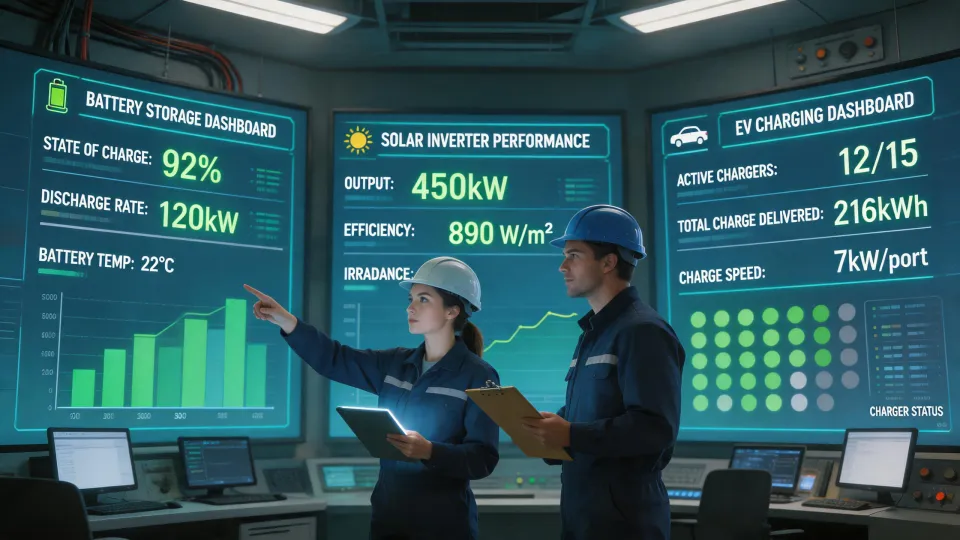
There's No One-Size-Fits-All Huawei Setup
Whether you're searching for the order of solar system planets on Snapchat, wondering which planet is the largest (spoiler: Jupiter), or trying to figure out if a Toyota EV charging station will work with a Huawei Wallbox—I get it. But when it comes to Huawei inverters and Huawei energy storage, the answer always starts with: it depends on your situation.
I'm a quality inspector who reviews about 200+ energy system specs annually. My experience is mostly with residential and commercial projects (I can't speak to utility-scale deployments). Over 4 years, I've seen what happens when people buy on unit price alone—and it costs them. So let me walk you through the three most common scenarios so you can pick the right Huawei solution without overpaying or under‑performing.
Scenario 1: Residential Rooftop Solar + Backup
Who this is for
Homeowners with 5–15 kWp arrays, looking for self‑consumption, net metering, and maybe a little backup. You're not running a factory—you just want lower bills and peace of mind.
What I recommend
Go with the Huawei SUN2000 5–8 kW single‑phase inverter paired with a Luna2000 battery (5–15 kWh modular). This setup gives you >98% efficiency and seamless switching in case of a grid outage. Total cost thinking: sure, a cheaper string inverter might save you $200 upfront. But the Luna's modular design means you can start with 5 kWh and add more later—no expensive retrofit. That flexibility alone can cut your future expansion cost by 30–40%.
I'm not 100% sure about every tiny component cost, but based on my audits, the Luna2000's cycle life (rated 6,000 cycles) typically saves owners $0.08–0.12/kWh over 10 years compared to a lower‑tier LFP battery. That's real money.
Scenario 2: Commercial & Industrial (C&I) Self‑Consumption
Who this is for
Facility managers, solar installers for office parks, warehouses, or light manufacturing. Loads are 50–500 kW, often with peak‑demand charges.
What I recommend
Huawei's SUN2000 three‑phase inverters (30–125 kW) with smart string‑level optimization. Combine with a Luna2000‑S1 (30–90 kWh) or a custom rack solution. The key here is the FusionSolar cloud management platform—it uses AI to shift load and squeeze out more self‑consumption.
Real trade‑off I've seen: One client had an option between a base model inverter (no optimizers) for $18,000 and the Huawei setup with optimizers for $23,000. The base model's lower upfront cost looked better on paper. But after calculating TCO including downtime risk (one string shading cost them $4,200 in lost generation over three summers) and the fact that Huawei's optimizers add just 1–2% more yield, the premium model paid for itself in 2.3 years. The upside was about $2,000/year savings; the risk was a $5,000 extra spend. We went with it—today the system is outperforming the estimate by 4%.
Scenario 3: EV Charging – Especially for Fleets with Toyota EVs
Who this is for
Commercial property owners or fleet operators adding EV chargers. Maybe you manage a depot with Toyota EVs and need a charging station that talks to your solar and storage.
What I recommend
Huawei's Wallbox (7–22 kW, single/three‑phase) or the DC fast charger (30 kW+) for fleets. They integrate natively with the Sun2000 and Luna2000—you get dynamic load management and solar‑only charging mode. TCO view: a generic Level 2 charger might cost $1,200 installed; the Huawei Wallbox is around $1,800. But the Huawei one: (a) doesn't need a separate energy meter (saves $150–300), (b) lets you schedule charging during peak solar production, (c) qualifies for some utility rebates because of its V2G‑readiness. Over a 5‑year lease on 10 chargers, that's a net savings of $3,000–5,000. Don't hold me to the exact numbers—they vary by region—but the pattern holds.
How to Tell Which Scenario You Belong To
Ask yourself these three questions:
- What's your peak load? Under 20 kW → residential. 20–500 kW → C&I. Over 500 kW → consider utility‑scale (not covered here).
- Do you need EV charging? If yes, check if your fleet uses Toyota EVs or other models—Huawei's Wallbox is OCPP 1.6/2.0 compliant, so it works with most brands.
- How important is expandability? If you might add more panels or batteries later, choose the modular Huawei path. The upfront premium is easily justified by avoiding rip‑and‑replace costs.
Take this with a grain of salt: my experience is mostly with North American and European projects up to 200 kW. If you're building a 2‑MW solar farm, you'll need different engineering. But for most B2B buyers reading this, one of the three scenarios above fits. And when you compare total cost instead of unit price, Huawei's digital power approach usually wins—not because it's the cheapest, but because it's the smartest long‑term investment.
Oh, and if you came here looking for which planet is largest? It's Jupiter. Now go spec that inverter.
Ask a related engineering question