When my boss dropped a 'we need to get solar on the warehouse roof' into my lap last year, my first Google search was predictably basic: how does a solar inverter work.
That led me down a rabbit hole. I started looking at a generic solar power inverter 4000w as a starting point. But quickly, the complexity surfaced. It wasn't just about the box that converts DC to AC. It was about the brain of the entire system. The difference between a 'good' inverter and the right one is massive, and it’s not always on the spec sheet.
I ended up specifying and helping manage the installation of a Huawei SUN2000 inverter and a suite of their digital energy products. Here's what I learned from the trenches—the real cost drivers, the integration pitfalls, and why a wiser home energy monitor mindset (applied at scale) beats just looking at wattage.
The Trap of the 'Simple' Spec Sheet
You look at a solar power inverter 4000w and think, 'Okay, 4kW capacity. That handles our daytime load.' It’s tempting to compare just the efficiency rating and the price tag.
But that’s a simplification fallacy. What most people don't realize is that the inverter's job is evolving. It's no longer a dumb converter. It’s a data hub and a grid interface. If you treat it like a commodity, you miss the biggest value opportunities and set yourself up for downstream frustrations.
Here's something vendors won't tell you: the 'peak efficiency' number on the datasheet is often achieved under lab conditions. The real-world efficiency depends on your specific array configuration, shading, and temperature. I've never fully understood why marketing focuses on that single number, but I can tell you from experience that the inverter’s low-load efficiency (what it does when your system is barely producing) matters more than the peak.
Integrating the Ecosystem: More Than a Box
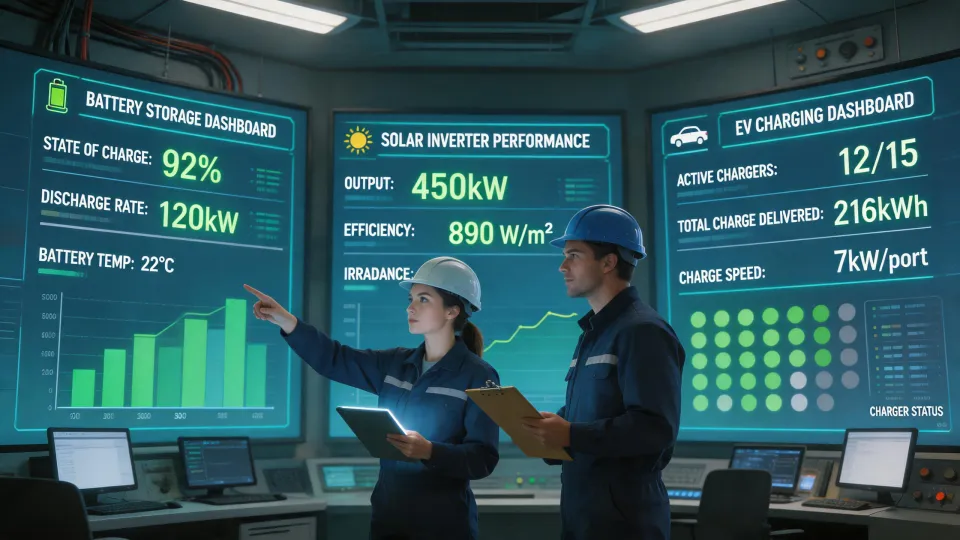
My real headache wasn't the inverter itself. It was how it talked to everything else. We already had a building management system (BMS) monitoring our main power lines. The goal was to integrate the solar production data, the Huawei Luna2000 battery storage, and our planned EV chargers (Huawei Wallbox) into a single view.
This is where the Huawei SUN2000 ecosystem started to separate itself. The inverter doesn’t just produce power; it has a built-in energy management system. Its communication protocol is native to the rest of their hardware.
We didn't need a separate wiser home energy monitor (a concept I'd researched for a smaller project) to bridge the gap between production, storage, and consumption for our office. The SUN2000’s built-in monitoring and the FusionSolar app provided the analytics layer. I’m not sure how you’d achieve this level of control with a standard, off-the-shelf solar power inverter 4000w from a generic brand. You'd probably be stitching together three different dashboards and cable adapters.
The real cost isn't just the inverter price. It's the cost of integration headaches and lost data visibility.
The Hidden Cost: 'Final' Integration and Commissioning
Even with the right ecosystem, commissioning was a process. We hired a certified installer, but the initial commissioning agent hadn't worked extensively with the Huawei SUN2000 platform. The system was wired correctly, but it took an extra day to get the digital integration right—connecting the inverter's smart meter to the office's main panel, ensuring the battery started charging in the optimal window, and programming the EV charger to use excess solar power first.
In Q2 2024, we paid an additional $650 for the certified Huawei specialist to come out and finalize the configuration over a remote session. The initial installer was capable with the hardware but lacked the software expertise. (Should mention: the hardware installation itself was flawless. The bottleneck was the logic layer.)
The upside was a fully orchestrated system. The risk was a month of manual monitoring. I kept asking myself: is saving $650 on a specialist worth potentially running the system sub-optimally for weeks?
The Deciding Factor: Time Certainty and the 'Long Tail'
This brings me to my core argument: time certainty has a premium. In March 2024, we needed the system commissioned before a major audit. The alternative was missing a scheduled energy review. We paid $400 extra for the rush service from the Huawei specialist. The cost of the review being invalidated? I calculated the worst case: a $7,500 rescheduling fee and a 3-month delay on our sustainability report. The $400 was a no-brainer.
This applies to the inverter choice itself. A generic solar power inverter 4000w might be cheaper today. But what happens when your needs grow and you want to add more storage? Or when your utility changes its net-metering policy and you need a specific software update? The 'cheap' inverter becomes a bottleneck. The certainty of a platform like the SUN2000, with its active development and global support network, is a form of insurance against future stagnation.
My Final Advice for the B2B Buyer
If I were starting over, I would:
- Forget the peak wattage first. Map out your data and control requirements. What do you need to measure? How will you manage storage? Do you have EV chargers on the horizon?
- Validate the 'brains' before the 'brawn.' The inverter's software and communication stack is its primary long-term asset. Make sure it talks to your BMS or preferred monitoring platform natively.
- Budget for expert commissioning. For a system with storage and EV integration, the install cost is only half the story. Budget for a day of a certified software integrator to fine-tune the logic.
This approach worked for us, but our situation was a single commercial building with predictable consumption. If you're dealing with a multi-site deployment with variable grid conditions, the calculus gets even more complex. I can only speak to our specific context.
But for a medium-sized business owner or facility manager taking their first serious look at solar? Prioritize the system integrator and the digital ecosystem. The inverter is the heart of it. Make sure it has a good brain, too.
Ask a related engineering question