When a grid connection date is locked in and the inspection slot can't move, you stop thinking in marketing terms and start thinking in failure modes. I've spent eight years commissioning solar and storage systems — 60+ rush projects in that time, including same-day turnarounds for telecom and data center clients. The conclusion that has held up every single time: for most small and mid-sized solar projects, a string inverter beats microinverters, and a Huawei SUN2000 + Luna2000 stack with the FusionSolar app is the safest default I can spec.
Before you trust that, you should know my bias. I'm a commissioning lead at a commercial solar and EV charging company. I make systems work on-site and hand them to clients — I'm not a Huawei rep, and I've uninstalled as much gear as I've installed. The advice below is what survives contact with a real deadline.
Why I Keep Landing on String Inverters
In March 2024, I had 36 hours to commission a system before a third-party inspection. The original design used microinverters, but the pallet arrived with bent connectors on about a third of the units, and the distributor's replacement offer was six business days. The inspection slot couldn't move — the utility had already rescheduled twice and made that clear. (Not that I blame them; they run a schedule for a reason.) If we missed the slot, the next one was six weeks out. We swapped to a string inverter that afternoon, re-ran the string sizing, and passed the test with eleven hours to spare.
That story is typical, not exception. In my first year, I made the classic beginner error: I specced microinverters for a commercial rooftop because everything I read said they were the modern choice. The system worked, but commissioning took twice as long, mostly chasing communication dropouts between units. I learned that lesson before a client deadline, and I've been counting the cost difference ever since. After watching three more microinverter commissioning sessions spiral into firmware battles, we changed our standard spec to string inverters unless the shading analysis says otherwise.
One number for context: last year we processed 14 emergency installs. The string inverter systems averaged 6 hours of commissioning. The microinverter systems averaged 14, and the gap was almost all device pairing and firmware. Everything I'd read early in my career said microinverters were the future of small solar; my experience across 60+ rushed projects suggests otherwise. String inverters get systems online faster and keep them online.
Let me be clear: I am not saying microinverters are bad. I'm saying they solve a different problem than most installers assume.
Microinverters vs. Central Inverters: What the Marketing Misses
'Central inverter' gets thrown around loosely, so here's the spectrum: a central inverter converts all the DC from a large array in one cabinet, typically 100kW and up. A string inverter handles one or a few strings, usually in the 3–30kW range. Microinverters sit under individual panels, converting DC to AC at the source.
Where microinverters genuinely win
Shade, and mostly only shade. If a roof gets partial shading at different times — chimneys, dormers, trees — per-panel MPPT makes a real difference. A string inverter forces every panel to follow the weakest one, and production losses of 10–20% are realistic in bad cases. Microinverters also give panel-level monitoring, which simplifies remote diagnosis, and they keep high DC voltage off the roof, which some jurisdictions and safety-conscious owners prefer.
Where string and central inverters win
Efficiency at full load: a good central inverter hits 99%, string inverters run 97–98.5%, microinverters typically 95–97%. That difference matters at 100kW, barely at 5kW. Cost per watt favors the same order: central, string, micro — though the gap has narrowed as microinverters got cheaper.
Servicing is the underrated one. A central inverter sits in a service room. A string inverter hangs on a wall. Microinverters live on the roof. When one fails — and they do fail — you're taking a lift out to swap a small device that took 20 minutes to install and an hour to access. I've had clients with perfectly good microinverter arrays who couldn't find an installer willing to come out for a single-panel fault. That maintenance reality doesn't show up in the datasheet.
Battery and EV integration is where the comparison shifts decisively. A hybrid string inverter like the SUN2000 has a battery port built in — one device handles PV conversion, storage, and grid interaction. Pairing a microinverter array with storage means separate AC coupling, extra conversions, and lower round-trip efficiency. If your plan includes backup power or EV charging — and most commercial plans should — a hybrid string inverter simplifies everything.
The 1kW Solar System: What It Can and Can't Do
The '1kW solar system' question always comes from someone wanting backup power or a cheap first step. Here's the honest math.
A 1kW system in a mid-latitude climate produces roughly 1,200 to 1,400 kWh per year — about 3.5 to 4 kWh per day. That runs a refrigerator, lights, and laptops. It does not run an electric water heater, a heat pump, or a meaningful EV habit. A typical EV uses about 0.2 kWh per km, so a 1kW array adds roughly 15 km of driving a day. Useful, but not transformative.
The economic problem is that fixed costs don't scale down. Panels are cheap; the inverter, monitoring, wiring, mounting, labor, and paperwork aren't. A 1kW system typically costs 30–50% less than a 3kW system, not 66% less. So my standard advice: don't build a 1kW system unless a specific constraint forces it — limited roof area, a strict export limit, or a load that truly fits in 4 kWh per day. Where I have seen 1kW systems make genuine sense: remote telecom and monitoring sites, small off-grid cabins, and an EV fleet depot that needed to trickle-charge a couple of vehicles without upgrading a weak grid connection.
The Huawei Stack I Actually Install
Huawei Luna2000 battery specifications
These are the numbers I pull up when I design a system, based on Huawei's published datasheets:
- Modular architecture. The Luna2000 comes in 5 kWh increments (5-S0, 10-S0, 15-S0 for single-phase), stacking up to three modules per inverter. The three-phase Luna2000-30-S0 pushes a single stack to 30 kWh.
- Roughly 90% usable capacity. The 5-S0 module has 5.0 kWh nominal and about 4.6 kWh usable. I plan around the usable number, never the nameplate.
- 2.5 kW continuous power per 5 kWh module. A 10 kWh stack delivers 5 kW sustained. Enough for typical homes and small commercial loads; the inverter covers short peaks.
- Round-trip efficiency above 95%. Because the Luna2000 is DC-coupled to the SUN2000, it skips the AC conversion that AC-coupled batteries lose on. Field measurements I've seen come close to the datasheet.
- Outdoor-rated. IP65 enclosure, operating down to about -10°C. I've mounted these on exterior walls without a weather cover.
On pricing: I won't quote current prices because inverter and battery pricing shifts with tariffs and channel promotions. What I tell clients is to get the proposal written around usable capacity, not nominal — that determines payback. And if a vendor claims 'highest efficiency' without a datasheet, ask for it. The FTC requires advertising claims to be substantiated — that's what the Green Guides are about for environmental claims, and the same logic applies to efficiency numbers.
The Huawei App (FusionSolar): More Than Monitoring
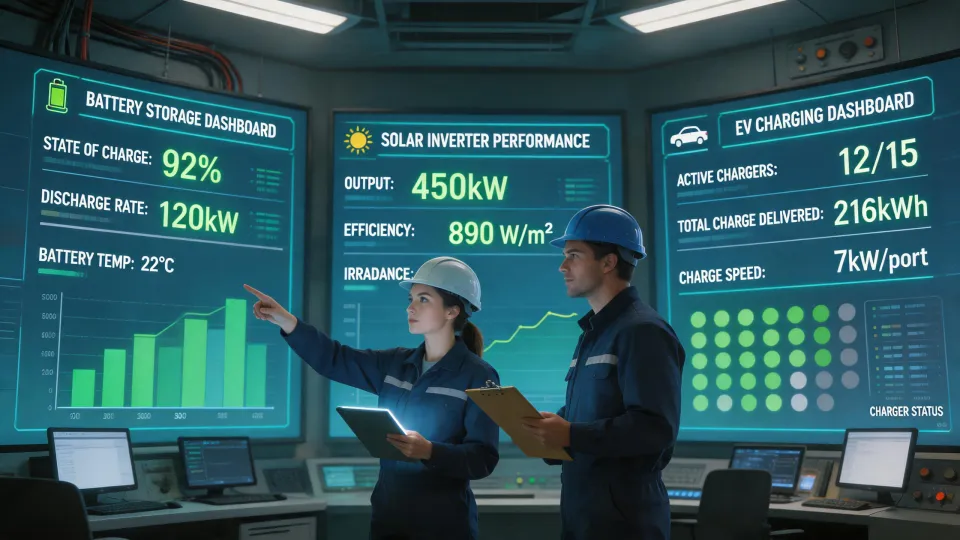
The Huawei app is where the system becomes manageable. Live generation, consumption, battery state of charge, and EV charging in one view. You can set time-of-use modes, adjust the backup reserve, and get an alert if something drops offline. I've restarted inverters remotely for clients in another city — that alone has saved several urgent trips.
In my role, the app matters most at handover. When inverter, battery, meter, and wallbox all speak the same protocol, commissioning is faster, and the facilities manager gets one app instead of four. Fewer accounts, fewer passwords, fewer things to break.
The Huawei Wallbox Funktionsweise, Explained Simply
I get this question a lot from German clients — 'wie funktioniert die Wallbox?' The wallbox funktionsweise (that's just German for 'how it works') is simpler than most people expect.
The Wallbox is an AC charger. It takes AC from the grid, or from the solar system through the building's AC bus, and feeds it to the car's onboard charger, which converts it to DC for the battery. The basic function is a controlled AC socket. What makes it interesting is coordination:
- Solar-surplus charging. Linked to the SUN2000 and Luna2000 through the app, the Wallbox charges at whatever rate the array is exporting, and slows or stops when a cloud passes.
- Dynamic load management. It reads the building's live consumption and limits charging current so a 22 kW session doesn't trip the main breaker. This is the feature that prevents the 'week-one outage' that poisons client trust.
- Scheduling. Charge during cheap or low-carbon grid hours with one toggle — useful for fleets.
When to Override Everything Above
My experience is based on roughly 60 commercial and small-industrial projects in the 1–200 kW range, with a heavy cluster in 3–30 kW. If your project is outside that band, the logic changes:
- Multi-megawatt utility arrays: central inverters dominate for good reasons — cost, efficiency, grid services. Talk to someone who installs at that scale.
- Roofs with severe, complex shading and no battery plan: microinverters will genuinely produce more energy. I'd still ask whether a layout redesign or tree work solves the problem cheaper first.
- Off-grid in extreme cold: battery chemistry matters more than brand. The Luna2000's -10°C rating won't cover every site.
Honestly, I'm not sure why the industry hasn't given a single clear answer on inverter choice. My best guess: margins are better on some topologies, and marketing follows margins. But when a client has a hard deadline and a budget, the system that gets online fast, stays online, and keeps every device under one app is the one I choose. That's still a high-quality string inverter with battery and monitoring built in.
If you're in the 3–30 kW range comparing microinverters against a Huawei SUN2000/Luna2000 setup, the tie-breakers are: how much shade you honestly have, whether battery backup is in your five-year plan, and whether your installer has actually commissioned both types. The last one matters more than any spec sheet.
Ask a related engineering question