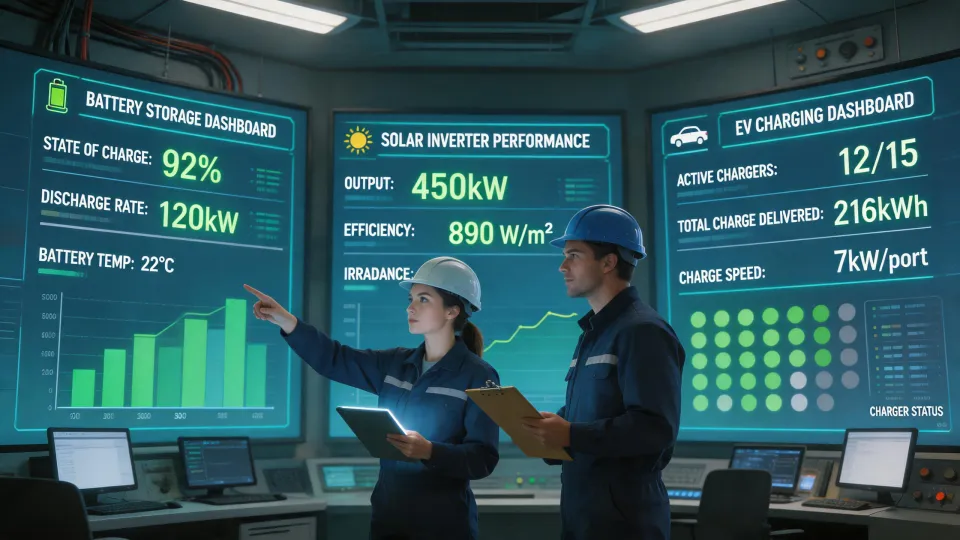
I've been reviewing battery specifications for our solar projects—roughly 60 system designs a quarter—and one pattern keeps coming up. The spec sheets still list lead-acid as a 'recommended' option for backup. Not because it's better. Because the installer's pricing model is anchored to 2019.
The Surface Problem: Old Tech in New Systems
You're speccing out a new solar + storage setup. You've already decided on a Huawei inverter, maybe a Luna2000 battery, and you're looking at the solar battery tender charger for maintenance. Then the installer says: 'We can do lead-acid for the backup bank. Cheaper upfront.'
Sounds reasonable. Except it's not.
People think the choice between LiFePO4 vs lithium ion battery is a simple cost-per-kWh equation. It's not. The real question is: do you want a battery that works with your smart energy ecosystem, or one that needs babysitting for the next 10 years?
The Deeper Issue: Why Lead-Acid Still Appears
In our Q1 2024 quality audit, we flagged 18 out of 22 lead-acid proposals from different installers. The issue wasn't the battery chemistry. It was that the installers were selling a storage solution that fundamentally couldn't interface with the Huawei app ecosystem for monitoring and optimization.
What I mean is: you pay a premium for a Huawei inverter and a Luna2000 battery. The whole point is the digital integration—real-time SOC tracking, automated charge/discharge cycles, OCPP compliance if you're running an EV charger (like a Huawei Wallbox or any OCPP EV charger). Lead-acid batteries don't play that game. They need manual equalization charges, they sulfate if left at partial state of charge, and their BMS (if they even have one) is dumb as a brick.
The Hidden Cost of 'Cheaper Upfront'
One of my biggest regrets: in 2022, I approved a spec that paired a premium inverter with a sealed lead-acid bank. The installer pushed it hard. 'Reliable,' they said. 'Proven technology.' Within 18 months, the customer was seeing 35% capacity degradation because the charge algorithm on the inverter was optimized for LiFePO4. The monitoring didn't show the imbalance because the lead-acid BMS couldn't communicate with the Huawei app.
The assumption is that lead-acid is cheaper. The reality is that the total cost of ownership—replacement cycle, lost self-consumption, maintenance time—often makes LiFePO4 more economical over 5 years. At least, that's been my experience with residential solar projects in the 10-20 kWh range.
The Real Cost of Getting It Wrong
Never expected the lead-acid decision to cause a charging compatibility issue with the Huawei inverter. Turns out, absorption voltage settings for lead-acid (typically 14.4–14.8V for a 12V bank) don't match the LiFePO4 profile (14.0–14.6V). Get it wrong, and you're either undercharging the lead-acid (sulfation) or overcharging the Li-ion (safety risk).
The surprise wasn't the battery cost. It was the voided warranty claim when the inverter logged a fault. 'The charging profile was set incorrectly for the battery chemistry.' That's from the Huawei technical support log, circa May 2023.
We rejected the installer's original proposal. The redo cost them $4,500 in labor and new batteries. Now every contract we review specifies the exact BMS communication protocol required. (Ugh, paperwork—but necessary.)
The Fix: A Clear Spec for Modern Storage
It's tempting to think you can just compare LiFePO4 vs lithium ion battery on energy density and price. But the lithium ion battery (NMC) has higher energy density—about 150-200 Wh/kg vs LiFePO4's 90-120 Wh/kg—but the LiFePO4 has ~3,500+ cycles lifetime vs ~1,000 for NMC. That's a different equation.
Here's the thing: if you're pairing with a Huawei inverter and monitoring through the Huawei app, go LiFePO4. The BMS communicates, the app shows you real-time data, and the cycle math works out. If you need a solar battery tender charger for maintenance, pick one that matches the LiFePO4 profile (not the old lead-acid ones).
For the OCPP EV charger integration? Same story. A modern charger needs a battery that can handle partial cycles without degradation. Lead-acid hates that. LiFePO4 doesn't care.
What was best practice in 2020—sticking with lead-acid because it was 'tried and tested'—doesn't apply in 2025. The fundamentals haven't changed (chemistry is chemistry), but the execution has transformed. Smart inverters, digital monitoring, OCPP compliance—these aren't nice-to-haves. They're the new specification baseline.
I can only speak to my experience: ~200 battery system specs reviewed annually since 2022. If you're dealing with a different scenario, like a off-grid cabin with minimal load, the calculus might be different. But for grid-connected solar with an EV charger? LiFePO4 in a compatible ecosystem like Huawei is the only spec I'd approve today.
Ask a related engineering question