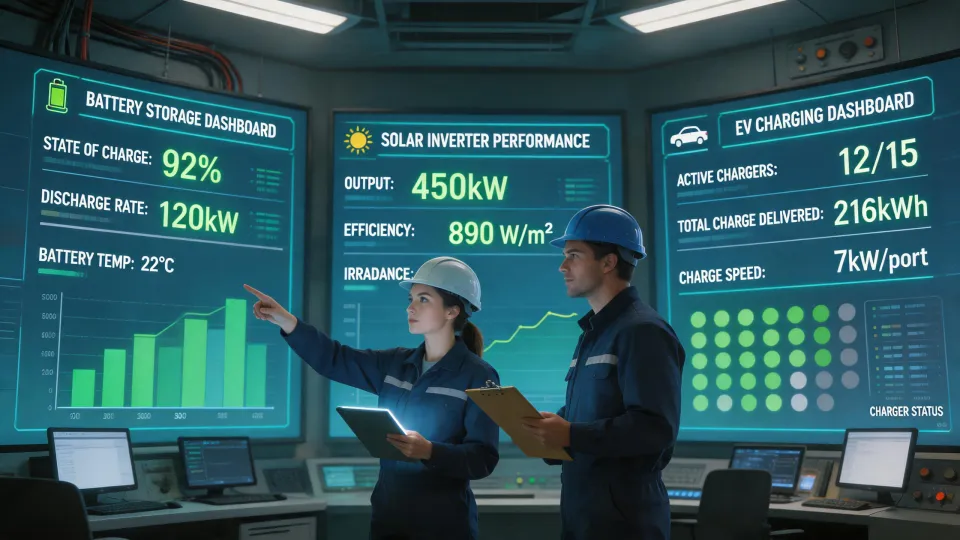
I manage purchasing for a mid-sized office building—think 150 employees, three floors, a small parking lot, and a growing number of electric vehicles. When the facilities manager mentioned solar, I had a lot of questions. After digging into Huawei's commercial solar gear (the SUN2000 inverters, the LUNA2000 battery, and their Wallbox EV chargers), here are the answers I wish I'd had from day one. Pricing is based on quotes I gathered as of January 2025; always verify current rates.
1. Can Huawei solar gear really handle the load of an office building?
Short answer: Yes, but you need to size it right.
From the outside, it looks like these are "home" products. The reality is their commercial-line SUN2000 inverters are built for it. We looked at the SUN2000-12K-MB0 for our roof. It's a hybrid inverter, meaning it manages both solar panels and battery storage in one unit. The key is matching it to your peak load. For our office, we peak at around 15 kW during mid-day. The 12 kW inverter covers most of that, and the grid handles the rest. Pro tip: Don't just look at the inverter's max power—check its minimum startup voltage. Some cheaper inverters won't even turn on with low winter sun. The Huawei starts at a very low voltage, which is a real advantage.
2. Grid-tie inverter vs. hybrid inverter: which one for an office?
I went back and forth on this for a week. A grid-tie inverter is cheaper, but it's dumb—it shuts off during a power outage. A hybrid inverter stores energy in a battery and can keep critical circuits running when the grid goes down.
My take: For an office building, a hybrid inverter is the smarter choice. The price difference isn't huge (maybe $300–$500 on a $2,000 inverter), and the payoff is enormous if you lose power during a workday. In Q3 2024, we had a two-hour outage, and I realized we can't run the servers or the front desk. A hybrid setup with the LUNA2000 battery (which we later installed) would have kept us online. Here's something vendors won't tell you: many grid-tie inverters require a separate battery inverter later if you want storage anyway. The Huawei hybrid is a single unit, saving installation complexity.
3. How long does the LUNA2000 battery last for an office?
It depends on what you're powering. The LUNA2000 has a modular design—you start with a base unit (5 kWh) and stack modules to add capacity. For our office, we went with the 10 kWh config (two modules).
Here's the math:
- Base load (lights, alarms, routers, one server): ~1.5 kW
- Peak backup load (add 2 workstations, a small fridge, and a fan): ~3.5 kW
A 10 kWh battery gives you about 3 to 6 hours of backup, depending on the load. That's enough to ride out most outages or do an orderly shutdown. What most people don't realize is that lithium batteries degrade faster if they're fully cycled every day. The Huawei system's software stops discharging at 20% to protect the battery, which extends its life. Our installer said we'll get 10+ years easily. That peace of mind is worth the upfront cost.
4. Is the Huawei Wallbox (EV charger) worth it for office parking?
We have 8 parking spots, and 3 employees already own EVs. My biggest worry was: will one charger cover everyone?
The Wallbox 3 kW (single-phase) is the entry-level model. It's slow—about 12–15 miles of range per hour of charging. For an office where cars sit for 8 hours, that's fine. An employee with a 40-mile commute can easily top up during the day. The Wallbox also has load balancing. That means if you install two units, they'll talk to each other and share the building's available power. You don't need a massive electrical upgrade.
Honestly, the killer feature for an office is the smart app. I can set charging schedules to align with solar production (from the SUN2000 inverter). Free electrons from the roof, basically. Plus, the app routes excess solar power to the car, rather than selling it back to the grid for pennies. That's a feature I didn't know I needed until I calculated the ROI.
5. What about installation complexity? I'm not an electrician.
Fair point. Installation isn't a DIY project. You'll need a licensed electrician, and a specific Huawei-certified installer for warranty purposes. What most people don't realize is that Huawei provides very detailed installation documents and wiring diagrams. Even my electrician said, "This is cleaner than most commercial gear." The inverter and battery communicate via PLC (power line communication), meaning they don't need separate communication cables—just the power wires. That saved us about $400 in labor alone.
6. How did the Huawei system handle the ROI calculation?
This is where I did the real math. Baseline: our office pays $0.12 per kWh. A 12 kW solar system in our area produces around 14,000 kWh per year.
- Without battery: if you export excess solar at $0.04/kWh (net metering rates), you miss out. The ROI is 5-6 years.
- With battery and Wallbox: you store the solar energy and use it to charge cars. That effectively saves you the full $0.12/kWh. The ROI drops to 3.5–4 years.
My opinion? The battery and EV charger aren't luxuries; they're the engine of the ROI. A grid-tie inverter alone leaves money on the table.
7. Any hidden costs or gotchas I should watch out for?
Yes, two.
First: the Huawei monitoring app is powerful, but you do need to set up a Huawei account and configure it. It's not plug-and-play. Budget 30 minutes to an hour for a non-techy person to set up. Second: the LUNA2000 battery is heavy—about 100 lbs per module. You need a wall mount or a sturdy floor stand. Our installer charged a small fee for the mount kit, which I didn't account for initially.
Also, check your local utility's net metering policy. In some areas, you can't legally discharge battery power back to the grid without special approval. The Huawei inverter can be set to "self-consumption" mode only, which solves this legally. It's a setting in the app, but your installer should set it up properly.
So, bottom line: is Huawei solar gear right for an office building? If you want a system that talks to itself (inverter ↔ battery ↔ EV charger) and you're willing to invest in the full ecosystem, it's a solid choice. The hybrid inverter is the centerpiece. Don't cheap out on a grid-tie just to save a few hundred bucks—you'll regret it when the power goes out.
Pricing and regulations as of January 2025; verify current rates and local codes.
Ask a related engineering question